01/02/2026

Begum Zia's royal farewell
Shahin Abdul Bari and Shamiur Rahman Lipu | Published: 2026-01-01 19:31:07
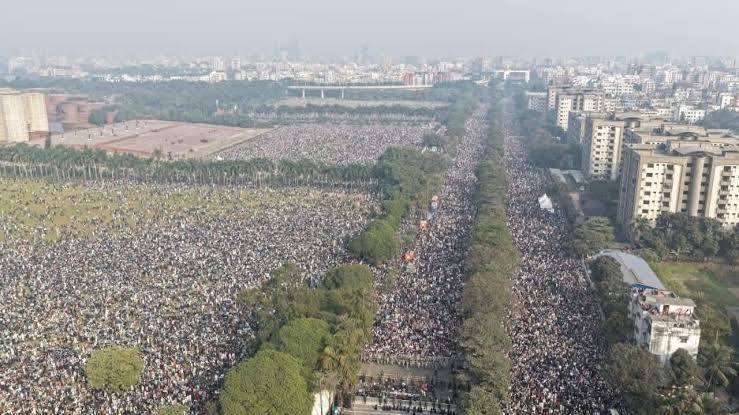
BNP Chairperson Begum Khaleda Zia bid farewell to the countless people whose rights she was arrested and imprisoned for fighting for; amidst the tears, respect, and heart-wrenching love of those people.
Even in this final farewell, BNP Chairperson and former Prime Minister Begum Khaleda Zia has created a unique chapter in the political history of Bangladesh. Manik Mia Avenue witnessed the largest funeral procession not only in the country but also in the history of the Muslim world.
BNP Chairperson, uncompromising leader of democracy and three-time Prime Minister Begum Khaleda Zia was laid to rest with state honours on Wednesday (December 31) at 4:40 pm next to the grave of her husband and former President Ziaur Rahman at Zia Udyan in Sher-e-Bangla Nagar in the capital.
After the state honors, the body carrier was carried by Dr. Mizanur Rahman Azhari, Allama Mamunul Haque and others. With heavy hearts, they carried the body of Begum Khaleda Zia on their shoulders to the tomb of martyred President Ziaur Rahman.
Millions of devotees broke down in tears as Khaleda Zia was lowered into the grave. The sky and air became heavy with the heart-wrenching cries of the leaders and activists. At this time, everyone wiped away their tears and prayed to Allah for Begum Zia.
Family members, top party leaders, and important figures from the state were present during the funeral. The entire area fell silent in grief and respect.
After the burial, she was given a guard of honor with state honors. During this time, the heads of the Bangladesh Army, Navy, and Air Force offered an armed salute to the deceased.
Earlier, after the funeral, Khaleda Zia's body was taken to Zia Udyan under special security arrangements. Law enforcement agencies took strict security measures to ensure the burial was carried out smoothly. No one other than the designated persons was allowed to enter there.
Begum Khaleda Zia has become an important chapter in Bangladeshi politics in her long political career. As a three-time Prime Minister, she played an important role in running the country. Her death has cast a shadow of deep sorrow over the country's political arena. People from different classes and professions, regardless of party or opinion, have expressed grief over her death.
Begum Khaleda Zia's colorful political career came to an end with a state funeral. However, her name will be remembered in politics and history for a long time.
The largest funeral in recorded history
The funeral of BNP Chairperson Khaleda Zia was held at the South Plaza of the National Parliament Building. A record number of devotees participated in it.
The funeral ceremony was conducted by BNP Standing Committee member Nazrul Islam Khan. Before the funeral, BNP Standing Committee member Nazrul Islam Khan highlighted the life and work of Begum Khaleda Zia. At one point while giving a short speech mentioning some of his memorable moments, he broke down in tears. At that time, his uncontrollable tears moved everyone present.
Although the funeral was scheduled to begin at 2 pm on Wednesday (December 31), the entire area turned into a mass of people at one point due to the presence of lakhs of people. As a result, the funeral was delayed considerably to avoid chaos and prioritize the emotions of the people.
Before the funeral, recitation of the Holy Quran and special prayers were held. Thousands of people queued up peacefully and in an orderly manner to participate in the funeral.
Finally, an hour after the scheduled time, Begum Khaleda Zia's funeral began with full religious dignity at 3:03 pm. Mufti Abdul Malek, Khatib of Baitul Mukarram National Mosque, led the prayer.
After the funeral of Begum Khaleda Zia was completed in a mournful atmosphere, prayers were offered for the departed soul. Many had tears in their eyes, while some silently raised their hands in prayer.
Earlier, Begum Khaleda Zia's body was brought to Manik Mia Avenue at 11:50 am. A heartbreaking scene unfolded there. Family members were present in a red-green bus with the body wrapped in the national flag.
Crowded Manik Mia Avenue
Lakhs of leaders, activists and ordinary people from different parts of the country gathered at Manik Mia Avenue and surrounding areas since early morning to participate in one of the largest funerals in the country's history.
The funeral venue, the southern plaza of the Parliament Building, was packed with people. It was as if there was no place to sit. The crowd of people who had gathered to attend the funeral not only spread across Manik Mia Avenue but also several kilometers around, forming a vast ocean.
At one point, this stream of people spread to alleys including Bijoy Sarani, Khamarbari Mor, Farmgate, Karwan Bazar, Panthapath on one side and Sher-e-Bangla Nagar, Asad Gate, College Gate and Shahbagh on the other.
During this time, people stood wherever they got the chance, including on the roofs of various buildings and overbridges. In addition, many people also stood at several nearby metro stations to offer Begum Zia's funeral prayers. Many others were unable to arrive on time due to the large crowd and failed to offer the funeral prayers.
Many were seen weeping as they were unable to attend the funeral of Begum Khaleda Zia, the most popular and undisputed politician in Bangladesh's history. It is believed that the country has not seen such a large funeral in the recent past.
Tarique Rahman's prayer and apology for his mother
Before the funeral began, Tarique Rahman, in an emotional speech on behalf of the family, asked for everyone's prayers for his recently deceased mother, Begum Khaleda Zia, and apologized.
He said, "I am Tarique Rahman, the eldest son of the late Begum Khaleda Zia. I would like to ask all the brothers and sisters present here today, if any of you have taken any loan from the late Begum Khaleda Zia while she was alive, please contact me. I will make arrangements to repay it, Insha Allah."
He also said, "At the same time, if anyone was hurt by any of his actions or words while he was alive, then on behalf of the deceased, I ask for your forgiveness. Please pray. May Allah grant him paradise."
Tarique Rahman finished his speech in just 50-60 seconds. In this short speech, he did not use any adjective for Begum Khaleda Zia even once. At that moment, for some time, it seemed to everyone present that the funeral of a very ordinary person was taking place.
Tarique Rahman did not even once try to make an emotional statement or portray himself as a victim in front of the millions of people present.
Where any ordinary person, once given the microphone, does not want to leave. He keeps saying whatever he wants; there Tarique Rahman came to speak on Begum Zia's behalf in front of millions of people, politicians, prominent figures from different walks of life and diplomats and controlled his emotions and said absolutely what he should not say. Then he quietly disappeared from public view.
Even in this sad moment of the death of his birth mother, Tarique Rahman has tried to change the long-standing political culture in Bangladesh. Although this task is not easy in the context of Bangladesh, he is leading it from the front. Today, even in the most difficult speech of his life, Tarique Rahman did not deviate from that effort even a single point.
Tributes to politicians and dignitaries
Begum Zia's funeral was attended by the interim government's chief advisor, Professor Dr. Muhammad Yunus, BNP acting chairman Tarique Rahman, Jamaat-e-Islami Amir Dr. Shafiqur Rahman, Jatiya Nagorik Party convener Nahid Islam and leaders of various political parties.
In addition, former and current members of parliament, political colleagues, personalities from the social and cultural spheres, and people from all walks of life attended the funeral.
During the funeral, Chief Justice Zubair Rahman Chowdhury was on the right of Chief Advisor Muhammad Yunus, followed by Jamaat-e-Islami Amir Shafiqur Rahman, and Khaleda Zia's son Tarique Rahman on the left of the head of government, followed by election expert Badiul Alam Majumder.
Along with the chief advisor, his government advisors Asif Nazrul, Adilur Rahman, Fawzul Kabir Khan, AFM Khalid Hossain, Ali Imam Majumder, CR Abrar, M Sakhawat Hossain stood in the same row and offered the funeral prayers. The chief advisor's press secretary Shafiqul Alam was also seen at the funeral.
Army Chief General Waqar-uz-Zaman, Navy Chief Admiral Mohammad Nazmul Hassan, and Air Force Chief Air Chief Marshal Hassan Mahmud Khan attended the funeral.
BNP Secretary General Mirza Fakhrul Islam, Standing Committee members Mirza Abbas, Abdul Moin Khan, Nazrul Islam Khan, Amir Khasru Mahmud Chowdhury, Salahuddin Ahmed, Iqbal Hasan Mahmud Tuku, Hafiz Uddin Ahmed, AZM Zahid Hossain, Senior Joint Secretary General Ruhul Kabir Rizvi, and BNP leaders and activists from all walks of life attended the funeral.
Among the politicians, Jamaat-e-Islami's Mia Ghulam Parwar, Shamim Sayedee, Mass Unity Movement's Jonayed Saki, NCP's Nahid Islam and Hasnat Abdullah, Bangladesh Khilafat Majlis' Mamunul Haque were present, Labor Party Chairman Mostafizur Rahman Iran was seen. DUCSU VP Sadiq Qayem, As-Sunnah Foundation's Ahmadullah also attended the BNP leader's funeral.
The interim government had declared Begum Khaleda Zia as a 'person of great importance'. After Begum Khaleda Zia fell ill, people of the country, regardless of party affiliation, wished her well. Political parties, rising above all else, forgot their ideological differences and prayed to Allah for Begum Zia's well-being. No leader in Bangladesh has ever received such sympathy.
Begum Zia's illness and death have brought the nation together on the same platform. This is a sign of the countrymen's undying love for Begum Zia. The way Begum Khaleda Zia, a symbol of national unity and democracy, has received undying love from people from all walks of life is unprecedented in the history of Bangladesh. This is a reward for the compassion she has shown for the country and its people during her long political life.
Respect from diplomats
The interim government has declared three days of national mourning following the untimely demise of Bangladesh's first female Prime Minister Khaleda Zia. A large number of foreign diplomats were present to pay their respects and attend the funeral.
Indian Foreign Minister S Jaishankar, Pakistan's National Assembly Speaker Sardar Ayaz Sabik, Bhutan's Foreign Minister DN Dhungel, Maldives' President's Minister for Higher Education, Labor and Skill Development Ali Haider Ahmed, Nepal's Foreign Minister Bala Nanda Sharma, and Sri Lanka's Foreign Minister Vijitha Herath came to Manik Mia Avenue today to pay their last respects to BNP Chairperson Begum Khaleda Zia, despite the severe cold.
In addition, the High Commissioner of the United Kingdom, ambassadors of 32 embassies including the United States, EU, Russia, China, Iran, Qatar, and heads of various missions in Dhaka also participated in the last procession at Manik Mia Avenue to pay tribute to Khaleda Zia on behalf of their respective countries.
Earlier, Begum Khaleda Zia's body was brought to Manik Mia Avenue at 11:50 am. A heartbreaking scene unfolded there. Family members were present in a red-green bus with the body wrapped in the national flag.
27 platoons of BGB were deployed alongside the police and RAB to ensure flawless security in the Parliament Building and Manik Mia Avenue areas on the occasion of the funeral.
Colorful political life
Begum Khaleda Zia's political life was full of struggle. Despite imprisonment, illness and political adversities, she never remained silent in her demand for leadership. Her life proves that politics is not just about power, it is about ideals, faith and sacrifice.
Begum Khaleda Zia is the Chairperson of the Bangladesh Nationalist Party (BNP), who has served as Prime Minister of Bangladesh three times since 1991. She is the country's first female Prime Minister and the second elected female head of government in the Muslim world.
Begum Zia's long political career was not just a story of reaching the pinnacle of power; it was a unique example of adversity, sacrifice, political fortitude, and leadership.
Begum Zia holds a unique record in the country's politics. Her unique record in electoral history is that she contested 23 seats in five national elections and won all of them. She was elected from five different seats in the general elections from 1991 to 2001. She also won all three seats she contested in the 2008 elections.
Under his leadership, parliamentary democracy was reintroduced in the country, which was an important milestone in the constitutional history of Bangladesh. As Prime Minister, he took various initiatives in the education, health, agriculture, women's development and social security sectors. His government's policies, especially in women's education and rural development, had a significant impact.
In 2001, Begum Khaleda Zia was elected Prime Minister for the third time and implemented various programs for the development of the country's infrastructure, poverty alleviation and economic reforms. At the same time, political rivalry, differences of opinion and controversy complicated her rule. Nevertheless, she remained a steadfast symbol of democracy and nationalism to her supporters.
She was born on 15 August 1945 in Dinajpur district to Iskander Majumdar and Taiba Majumdar. Her father migrated from Jalpaiguri, India, to the then West Pakistan after the partition. Their original home was in Feni. She studied at Dinajpur Government Girls' High School and later at Surendranath College. In 1960, she married Ziaur Rahman.
After Ziaur Rahman Bir Uttam became President, Begum Zia accompanied him on various state tours as First Lady. During this time, she met with leaders of various countries, including British Prime Minister Margaret Thatcher and Queen Juliana of the Netherlands.
From housewife to the top of power
The tragic assassination of President Ziaur Rahman in 1981 brought a profound change in Begum Khaleda Zia's life. Transforming personal grief into strength, she entered the difficult arena of politics.
It is worth noting that 44 years ago, President and BNP founder Ziaur Rahman was assassinated by a renegade group of army personnel. After President Ziaur Rahman was assassinated at the Circuit House in Chittagong on May 30, 1981, Khaleda Zia was staying in the Dhaka Cantonment with her two children.
At this critical moment in the country, the BNP was in turmoil. Discussions were going on about who would take over the leadership of the party. In such a situation, he joined the BNP as a primary member on January 2, 1982.
With political wisdom and determination, he was quickly elected as the party's senior vice chairman. He was elected the acting chairperson of the party on January 12, 1984, and the chairperson unopposed on May 10 of the same year. Later, he became the chairperson three more times in the councils of 1993, 2009, and 2016.
He faced various adversities since taking charge of the party. Keeping the party united, he built a movement against Ershad's dictatorship. He continued the movement in the interest of the country and the people without any compromise. This hastened Ershad's downfall.
He started a movement against Ershad Hatao in 1987, and as a result of a long struggle, the BNP won a majority in the national parliamentary elections held on February 27, 1991.
Khaleda Zia became Prime Minister for the first time in 1991. She then became Prime Minister for the second time on February 15, 1996, and for the third time in 2001 through a coalition election. She also served as Chairperson of SAARC twice.
Uncompromising leadership despite arrest and torture
His role in the democratic movement against military rule in the 1980s was courageous and steadfast. Despite arrests, persecution, and political pressure, he did not compromise. His leadership was historically important in the 1990 mass movement that brought down the dictatorship and restored democracy.
He was arrested on November 28, 1983, May 3, 1984, and November 11, 1987 during the anti-Ershad movement.
He was also arrested during the 11th. He was arrested on September 3, 2007, during the military-backed caretaker government. After a long imprisonment, he was granted bail in all cases. Although attempts were made to send him abroad while he was in prison, he did not leave the country.
After the Awami League came to power on November 13, 2010, he was evicted from his cantonment house. He had lived in this house for 28 years. After Ziaur Rahman was killed, the then President Abdus Sattar allotted the house in his name.
During the last Awami League government, 37 cases were filed against her. Since joining politics, she has become an uncompromising leader of the anti-dictatorship movement.
Despite intense pressure to leave the country, she did not budge from her position. In the last 15 years, she has faced various tortures and has also been in prison. Yet, Khaleda Zia did not compromise.
Begum Khaleda Zia's entire political journey has been a symbol of determination, uncompromisingness, and struggle. That is why she has become the name of unyielding struggle in the country's politics.
During the anti-Ershad movement, the military-backed caretaker government of One Eleven, and the 10-year rule of the Awami League government that fell in 2013, many conspiracies have been made to keep Begum Khaleda Zia's BNP away from the parliamentary elections or send her abroad. She has even been sent to jail. Brutal mental torture has been inflicted, but no one has been able to shake Begum Khaleda Zia from her position.
At that time, with a little compromise, he could have gone abroad like a king. He could have lived his life comfortably. But in response to being sent abroad, he repeatedly said, 'I have no place to go except the soil and people of Bangladesh. I cannot go anywhere without leaving this country and the people of this country.'
No government or organization in Bangladesh could send him to any country in the world despite applying thousands of fears, threats or pressures. But the inevitable death took him away forever today. He will not return to collect dust. However, he will be remembered forever in the minds of people. Begum Khaleda Zia's steel-hard determination and uncompromising determination in establishing patriotism, honesty and truth for the welfare of her motherland and the people will remain immortal in the history of the world.
Her passing today marks the end of an era. Begum Khaleda Zia will be remembered in the history of politics as a courageous female leader who led the country and the party with integrity despite difficult realities and set a strong example of women's empowerment in Bangladeshi politics. Her life and work will remain a source of inspiration for future generations.
Editor & Publisher : Md. Motiur Rahman
Pritam-Zaman Tower, Level 03, Suite No: 401/A, 37/2 Bir Protik Gazi Dastagir Road, Purana Palton, Dhaka-1000
Cell : (+88) 01706 666 716, (+88) 01711 145 898, Phone: +88 02-41051180-81