06/01/2026

BD’s election narratives can influence global confidence: Stefan Liller
Diplomatic Correspondent | Published: 2026-02-01 19:32:13
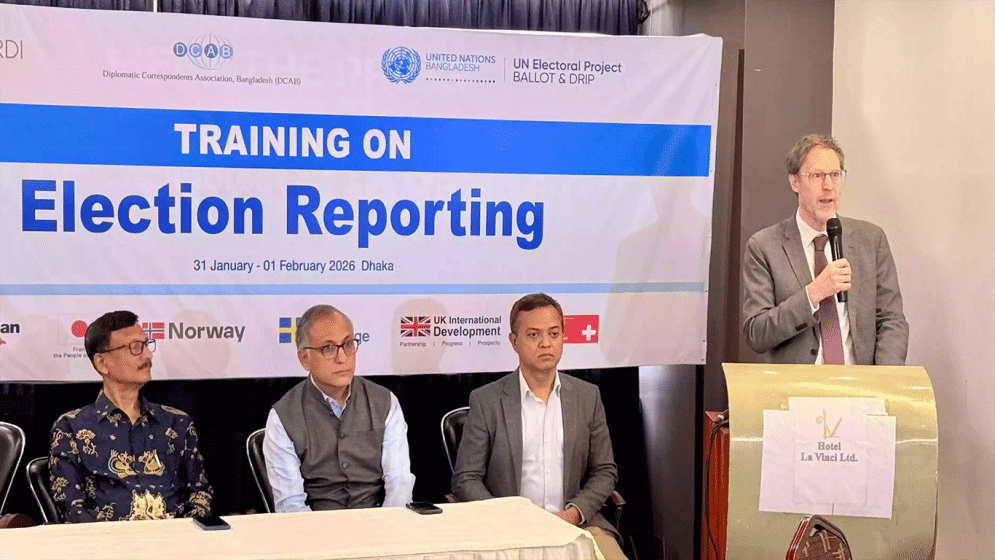
UNDP Resident Representative for Bangladesh Stefan Liller on Sunday said the election reporting today extends far beyond national borders and laid emphasis on maintaining three essential things - accuracy, neutrality and ethical judgment - while electoral reporting.
He said that reports produced by journalists in Bangladesh are closely followed by diplomats, international observers, development partners, investors and global media outlets.
“As a result, election narratives can influence international confidence, diplomatic engagement and perceptions of a country’s image and democratic maturity,” he said, adding that this places a particular responsibility on journalists covering elections in a diplomatic context.
Liller made the remarks while speaking at the closing session of the two-day training on election reporting, hosted by the Diplomatic Correspondents Association, Bangladesh (DCAB) in cooperation with the UNDP and Media Resources Development Initiative (MRDI).
Foreign Affairs Adviser Md Touhid Hossain spoke at the closing session as the chief guest while former Bangladesh Bureau Chief of the Associated Press (AP) Farid Hossain was the facilitator of the two-day session.
MRDI Executive Director Hasibur Rahman and DCAB President AKM Moinuddin also spoke at the closing session conducted by DCAB General Secretary Emrul Kayesh.
The United Nations, through the BALLOT and DRIP Projects, works in close partnership with the Bangladesh Election Commission to provide technical, material, institutional, and civic education support across the electoral cycle.
As Bangladesh approaches an important electoral milestone, Liller said, the role of journalists is both demanding and indispensable. “Democracy is sustained not only by laws and institutions, but by informed citizens. Journalists are central to that process.”
Liller, who is responsible for UNDP’s activities in the country, said electoral developments must be situated within Bangladesh’s constitutional and legal frameworks, as well as within its international commitments under the United Nations Charter, international human rights instruments and the Sustainable Development Goals, particularly Goal 16 on peace, justice and strong institutions.
He said responsible reporting helps ensure that moments of political contestation are understood internationally as part of a lawful, rules-based democratic process.
Liller said electoral processes are among the most technically and politically sensitive elements of democratic governance. “They involve complex legal frameworks, electoral codes of conduct, voter and candidate regulations, results tabulation systems, and complaints and dispute resolution mechanisms.”
In this context, the international development professional with over 20 years of experience said, journalists serve as a critical bridge between institutions and citizens.
When electoral processes are reported clearly, accurately and responsibly, Liller said, citizens are better able to understand not only what is happening.
He said at moments of heightened political competition, professional and ethical reporting contributes directly to public trust, democratic legitimacy and social cohesion.
Conversely, Liller said, misinformation or imprecise reporting can unintentionally amplify tensions and undermine confidence in electoral outcomes.
Information Integrity, Digital Risks and Journalist Safety
Across the world, Liller said, electoral environments are increasingly shaped by misinformation, disinformation, hate speech and digitally manipulated content.
He said the rapid spread of false narratives, including content generated or amplified through artificial intelligence, poses serious risks to electoral integrity and public trust. “Protecting information integrity is inseparable from protecting journalists themselves.”
Liller said journalists operating in unsafe or hostile information environments face harassment, intimidation and threats, both online and offline. “Safe journalists are essential to safe elections.”
By strengthening digital safety awareness and professional resilience, he said, they can help protect not only individual journalists, but the broader democratic process.
Gender, Media and Inclusive Participation
Liller said gender equality and inclusive participation are also central to democratic legitimacy. “Women candidates, activists and journalists are disproportionately targeted by technology-facilitated gender-based violence, including online harassment, intimidation, sexualised disinformation and doxxing.”
Doxxing is the act of researching and publicly publishing an individual's private, identifying information such as home address, phone number, or workplace - usually to facilitate harassment, intimidation, or harm.
Liller said such attacks are designed to silence voices and deter political participation. “The media plays a vital role in exposing these harmful patterns.”
By documenting cases, giving space to women’s experiences and framing these abuses as violations of democratic rights rather than private issues, journalists can contribute to greater accountability, he said.
By challenging stereotypes, amplifying women candidates’ agendas and highlighting the barriers they face both online and offline, the media can encourage broader participation and strengthen the representativeness of electoral processes, Liller said.
Editor & Publisher : Md. Motiur Rahman
Pritam-Zaman Tower, Level 03, Suite No: 401/A, 37/2 Bir Protik Gazi Dastagir Road, Purana Palton, Dhaka-1000
Cell : (+88) 01706 666 716, (+88) 01711 145 898, Phone: +88 02-41051180-81