06/06/2026

Nearly a mile long and 80,000 on board – welcome to the first floating city
Special Correspondent | Published: 2026-06-06 13:27:12
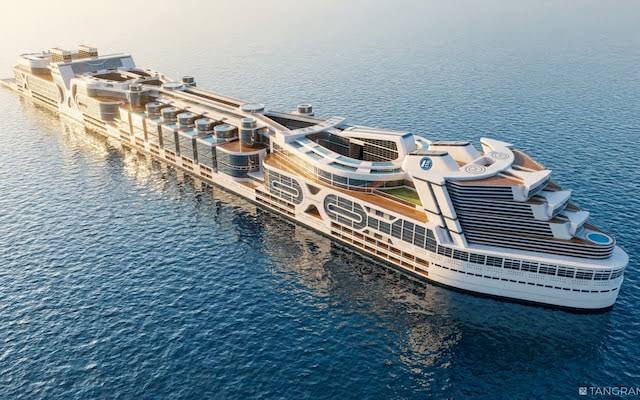
Monster cruise ships of today face being reduced to mere minnows by plans for a floating city that will carry 80,000 people around the world.
A mile-long, 800ft-wide and 30-deck-high, the £12bn Freedom Ship would house a research hospital as well as enough schools, shops and restaurants to serve a population as big as Chatham in Kent.
Likely to be powered by nuclear fuel, the 2.3-million-gross-ton giant will have homes for 50,000 permanent residents and space for another 10,000 cruisers and day visitors, all served by 20,000 crew.
Among the extensive facilities will be high-rise hotels, a 15,000-seat sports stadium, a convention centre, a water park, two museums and a symphony hall.
Divers will be able to swim in an enormous aquarium, while party-goers will dance the night away in a spacious club. A two-storey food hall will cater to residents who want a change from the wide range of dining venues.
Children will be educated from primary to college levels, while four decks will be given over to commercial services, financial branches, banks and retail. On top will be eight helipads.
The leviathan will also move, with a plan to circumnavigate the globe every couple of years at a stately seven knots. Too big to dock in any port, the ship will stay in international waters, transferring passengers to and from land by a fleet of ferries – even other cruise vessels could moor alongside.
Arriving visitors will be able to ride a tram system to a series of districts on board. Those who prefer to explore by foot can enjoy 15 miles of walkways and three acres of parks.
A concept 30 years in the making
While the Freedom Ship is yet to sail – or even begin construction – the idea behind it has been floating around for three decades.
It was first proposed in the 1990s by American engineer Norman Nixon, who died in 2012. The blueprints were dusted off publicly the following year, only to be mothballed again.
The proposal includes several schools
So why has it resurfaced now? Roger Gooch, chief executive of Freedom Cruise Line International, has taken on a project manager, a designer and a naval architect among a 12-strong leadership team and insists the demand is strong, claiming: “We could almost justify building three ships!”
Now it’s just the small matter of raising the start-up money. “We feel very confident that we can put this together, but the capitalisation is key,” he admits on a Zoom call from his Florida office.
Build it and they will come
Once finance is in place, the next step would be to start constructing the ship in Indonesia, beginning with the hull, which would have to be built in pieces then assembled offshore.
Though it could take three or four years to finish, Gooch says people could start living on board midway through construction. Then all future upkeep would be carried out at sea: “Maintenance on our hull would actually be done while it’s in the water every day, even while it’s moored off shore. The ship will constantly circumnavigate the globe, it never has a home port.”
Part of the income would come from the retail ventures. “We want entrepreneurs to lease or buy space from us, just like they would in a land-based community,” he says.
Gooch continues: “We’re not interested in owning every barber shop, every pizza outlet. There will be a few businesses that the holding company will have an interest in. One of them would be the casino, certainly.
“We also want a state-of-the-art hospital. We’ve been approached by medical research facilities because we would be outside the reach of regulatory bodies, so the Freedom Ship would be an ideal venue for that.”
Green ambitions and nuclear-powered travel
There will be a philanthropic side as well, with Gooch claiming the ship will clean the oceans as it crosses them. And using nuclear power would slash carbon emissions: “We want to prove we’re a green environment and we’re doing good for society in the world.”
The Freedom Ship would also not overwhelm small ports because it would remain offshore, and would actually attract visitors to enjoy its facilities at sea. “We want people to come out and enjoy the floating city while it’s in their area because it may not be back for another two and a half years,” says Gooch.
The master planner behind the ambitious project is Kevin Schopfer, who specialises in arcology – a mixture of architecture and ecology. His past designs for floating coastal communities to counter the effects of rising sea levels have included a 40,000-population project called the New Orleans arcology habitat – or Noah.
He said, “We started with the view that the ship should not be a monolithic piece but visually comfortable, so we softened all the edges. We also want it to breathe, so we’ve gone to great lengths to allow walkways and green spaces.
“We have a soccer pitch, too. It’s not a massive stadium, but it could also be used for events and concerts. Taylor Swift came up in the discussion at one point, but I said I don’t know if we can handle that!”
How it compares to today’s mega cruise ships
With capacity for 80,000 passengers and crew, the Freedom Ship would carry more than eight times the number of people who sail on what is now the world’s biggest passenger vessel, Royal Caribbean’s Star of the Seas.
Over the years, many residential cruise ships have been proposed but so far, only millionaires’ haven The World and the much more affordable Villa Vie Odyssey have set sail.
However, the size of the task doesn’t faze project manager Sridev Mookerjea of Singapore’s Blossom Group. We meet at St Katharine Docks in London, where, over a cup of green tea, he reflects on a 30-year career in passenger and casino ship management.
“Perseverance and determination help people to achieve something in this world,” he says. “I believe that with Roger’s efforts, patience and desire to make this a success, the sky’s the limit. It’s a fantastic concept and I will put all my efforts into making it happen.”
Editor & Publisher : Md. Motiur Rahman
Pritam-Zaman Tower, Level 03, Suite No: 401/A, 37/2 Bir Protik Gazi Dastagir Road, Purana Palton, Dhaka-1000
Cell : (+88) 01706 666 716, (+88) 01711 145 898, Phone: +88 02-41051180-81