Deposit War Shifts to Short-Term FDRs
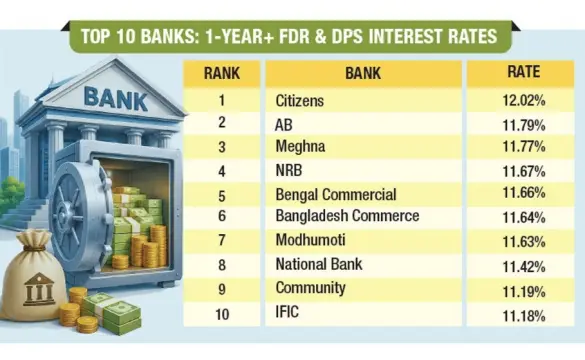
Lenders offer up to 12% interest as savers seek safety
Deposit War Shifts to Short-Term FDRs
Banks in Bangladesh are offering interest rates of up to 12% on short-term fixed deposits as they compete aggressively to attract fresh funds, capitalising on growing demand from households seeking safe and predictable returns amid weak performance in alternative investment markets.
The renewed competition for deposits comes as higher interest rates, improving confidence in the banking system and limited investment opportunities have prompted more Bangladeshis to return to bank savings, helping lift total deposits to a record Tk21.58 lakh crore by the end of March, according to Bangladesh Bank (BB).
Industry executives say banks are increasingly focusing on Fixed Deposit Receipts (FDRs) with maturities of less than one year, allowing them to strengthen liquidity while maintaining flexibility to adjust funding costs if market interest rates change.
"Short-term deposits provide banks with a stable funding source without locking them into high interest costs for extended periods," a senior banker said.
Banks intensify competition for deposits
Several lenders have introduced double-digit returns on short-term deposits, making them among the country's most attractive low-risk savings products.
AB Bank currently offers up to 12.01% on selected FDRs with maturities of less than one year, among the highest rates in the market. Meghna Bank offers up to 10.96%, while Standard Islami Bank, NRB Bank, Bengal Commercial Bank and several other lenders have also increased rates to attract new deposits.
Unlike previous years, when banks encouraged customers to commit funds for several years, many institutions are now prioritising shorter-term deposits as they seek to balance liquidity management with changing funding costs.
For customers, shorter maturities offer both competitive returns and greater flexibility, enabling them to reassess investment decisions within months rather than locking away savings for longer periods.
Safety outweighs risk
The appeal of bank deposits has strengthened as other investment avenues remain under pressure.
Bangladesh's stock market continues to struggle with subdued investor sentiment and weak trading activity. Although National Savings Certificates recorded net sales of Tk2,260 crore in April—the highest monthly figure during the first 10 months of fiscal year 2025–26—stricter eligibility requirements have limited access for many investors.
At the same time, record-high gold prices have made fresh investment expensive, while the property market continues its gradual recovery amid elevated construction and borrowing costs. Mutual funds and the corporate bond market also remain relatively underdeveloped, limiting their appeal to retail investors.
Against that backdrop, banks have regained their position as one of the most trusted destinations for household savings.
Deposits continue to expand
Bangladesh Bank data show total deposits in the banking sector rose to Tk21.58 lakh crore at the end of March 2026 from Tk19.23 lakh crore a year earlier, an annual increase of 12.19%.
Individual customers account for approximately 56% of total deposits, underlining the central role of household savings in financing the country's banking system.
Bankers say a stronger deposit base enables lenders to expand credit to businesses, exporters, manufacturers, farmers and small and medium-sized enterprises, supporting investment, employment and economic growth.
Confidence returns, but selectively
The recovery in deposits comes despite lingering concerns surrounding a handful of financially troubled banks.
Attention has focused on the newly established Sammilito Islami Bank, created through the merger of EXIM Bank, First Security Islami Bank, Global Islami Bank, Union Bank and Social Islami Bank under the Bank Resolution Ordinance.
Bangladesh Bank has assured customers that all deposits will be repaid within two years, although withdrawals have been phased and some depositors have reported delays in accessing their funds.
Financial analysts said the challenges remain confined to a limited number of institutions and do not reflect the condition of the broader banking sector.
They advised customers to prioritise financially sound banks with strong governance, adequate liquidity and reliable digital services rather than selecting institutions solely on the basis of the highest advertised interest rates. Many also recommended diversifying savings across multiple banks to reduce risk.
Stable returns regain appeal
For many households, bank deposits serve purposes that extend beyond investment.
Families use Deposit Pension Schemes to build long-term savings, retirees rely on interest income to supplement pensions, salaried employees maintain emergency funds and entrepreneurs temporarily park surplus cash before reinvesting in their businesses.
Unlike equities or property, fixed deposits offer certainty over both principal and returns, making financial planning easier during periods of economic uncertainty.
As Bangladesh's financial sector continues to evolve, banks' growing reliance on short-term deposits highlights a broader shift in investor behaviour: when uncertainty increases, safety, liquidity and predictable returns become increasingly valuable.
For now, that preference is translating into stronger deposit growth and intensifying competition among banks for household savings.
Shamiur Rahman