No credible timeline for repatriation as the burden of the crisis continues to grow
Rohingya Crisis: Nine Years On, the Road Home Remains Closed
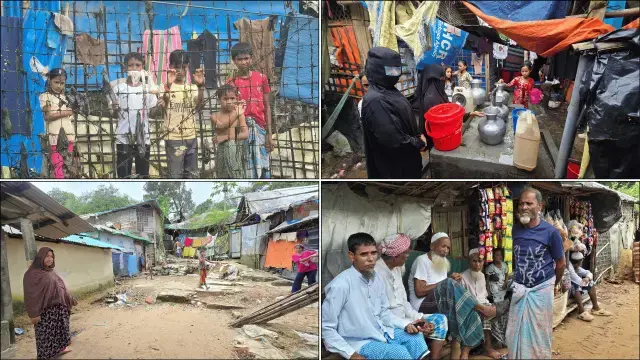
Not a single Rohingya has been repatriated in nine years. There is still no credible timeline for their return. Lists have been prepared, identities verified, meetings held and promises made—but the road home remains closed
August 25 has come around once again. It was on this day in 2017 that a massive influx of Rohingya refugees began arriving in Bangladesh after facing a brutal campaign of persecution in Myanmar’s Rakhine State. Within weeks, more than 700,000 people crossed the border and sought refuge in Cox’s Bazar.
Nine years have passed since then. Bangladesh has now entered the tenth year of the Rohingya crisis. Yet what tangible progress has been made on repatriation?
Not a single Rohingya has been repatriated in nine years. There is still no credible timeline for their return. Lists have been prepared, identities verified, meetings held and promises made—but the road home remains closed.
Recent reports on August 25 have once again highlighted the same grim reality. The question is therefore no longer only about the Rohingya. People in Ukhiya and Teknaf, who have been living alongside the world’s largest refugee settlements for years, are also asking: Where does this crisis end?
There can be no question about Bangladesh’s humanitarian responsibility toward the Rohingya. Providing shelter to people fleeing persecution was an act of humanity. But when temporary refuge turns into a permanent reality for years, its consequences extend far beyond the displaced population.
The pressure is increasingly visible in the lives, environment, economy and security of local communities in Ukhiya and Teknaf. It is therefore only natural that local residents want the Rohingya to return safely and with dignity to their homeland.
But that “return” has become the most difficult question of all.
Lists Move Forward, People Do Not
Bangladesh and Myanmar have been working for years on the verification of lists of Rohingya refugees. According to a statement issued by Myanmar’s Ministry of Foreign Affairs on August 15, Bangladesh has provided a list of 828,824 people. As of July 31, Myanmar had verified information on 426,545 individuals. Of them, 308,797 were identified as former residents of Rakhine State.
The numbers may suggest progress. But the real question is simple: Have even those whose identities have been verified been able to return home safely and sustainably?
The answer is still no. This is where the difference between administrative progress and real progress becomes clear. The number of people whose information has been verified is increasing, but the number of people actually repatriated remains zero.
Myanmar says the verified individuals will be accepted once the security situation in Rakhine becomes more stable. But there is no clear timeline for when that stability will be achieved.
In other words, the repatriation process is continuing, but repatriation itself has not begun. This is no longer merely a matter of administrative delay. After nine years, it has become a question of political failure as well.
War Is Now the Biggest Obstacle
The situation in Rakhine today is very different from what it was in 2017. The conflict between the Myanmar military and the Arakan Army has made the situation considerably more complicated. Control over large parts of Rakhine has changed, altering the realities on the ground and making earlier calculations about repatriation increasingly outdated.
Myanmar says repatriation can move forward once the security situation stabilises. But when will that stability come? Who will guarantee it? And who will ensure the safety of Rohingya refugees after they return?
People cannot simply be sent back in the middle of an armed conflict. Crossing an international border is not, by itself, repatriation. A genuine return must mean safety, security, dignity and the ability to rebuild a normal life.
Citizenship Cannot Be Avoided
At the heart of the Rohingya crisis lies the question of citizenship. For decades, a large section of the Rohingya population has remained effectively stateless, particularly following Myanmar’s 1982 Citizenship Law. Without citizenship and equal rights, what guarantees are there that those who return will not once again face discrimination and insecurity?
Safe repatriation does not simply mean escaping bullets and returning across the border. Safety must include recognition of identity, the right to live on one’s own land, rights to homes and property, and access to basic rights as citizens.
Recent statements from Myanmar have once again brought the long-running dispute over Rohingya identity to the forefront. This makes the questions of citizenship and identity even more critical to any future repatriation process.
Therefore, the question cannot simply be: How many people will be taken back? It must also be: Under what conditions will they return, and what rights will they enjoy once they are home?
New Arrivals, Old Crisis
Perhaps the most worrying development is that the old Rohingya population has not been repatriated, while renewed conflict in Rakhine has displaced even more people.
Fighting since 2023 has driven additional Rohingya into Bangladesh, putting further pressure on the refugee camps. More than 1.2 million Rohingya are now living in Bangladesh.
Bangladesh is therefore carrying a crisis that has not been resolved but has instead expanded with time. The pressure on local communities cannot be ignored either.
For years, people in Ukhiya and Teknaf have borne the burden of the crisis in the spirit of humanity. But the long-term impact on their economy, environment, public services, labour market and security deserves far greater attention in national policymaking.
Funding Exists, But Where Is the Local Voice?
Another major weakness in the Rohingya humanitarian response concerns funding and decision-making. A localisation study by Coast Foundation this year found that United Nations agencies account for 54 percent of representation in the Rohingya coordination structure, while international, national and local NGOs each account for 15 percent.
All eight major sectors are led by UN agencies. No local NGO holds a sector lead or co-lead position. A similar imbalance exists in funding.
According to the study, UN agencies receive 87.96 percent of funding under the Joint Response Plan, international NGOs receive 7.78 percent and national NGOs 4.26 percent, while the direct share of local NGOs is zero.
Between June and August 2025, 63 projects were approved in the camps, but only three were led by local NGOs. Just 2.5 percent of total funding went to local organisations.
The question is straightforward: Why is the role of those closest to the crisis so limited in the structures that control decisions and resources?
The Coast Foundation study has recommended increasing local NGO representation, introducing co-leadership at the sector level and raising the direct share of funding for local organisations to at least 25 percent.
This is not merely a demand from local NGOs. It is a call for a humanitarian response that is more effective, accountable and grounded in local realities.
August 25 Must Be More Than a Day of Remembrance
Many of the people who arrived in Bangladesh on August 25, 2017, have since raised their children on this soil. Some of their children have never seen any country other than Bangladesh. Yet many still dream of returning home.
The story of Mohammad Ariful্লাহ, who sought refuge in Kutupalong in 2017 with four members of his family, reflects that enduring desire. He walked for eight days to reach Bangladesh to save his life. Even after all these years, his wish remains simple: to return to his homeland.
That aspiration cannot be ignored. August 25, therefore, cannot be merely a day to remember the persecution and suffering of the past. It should also be a day to make decisions about the future.
Bangladesh must intensify international pressure for the safe and dignified repatriation of the Rohingya. At the same time, the international community must recognise clearly that Bangladesh cannot carry the burden of this crisis indefinitely on its own.
What is needed is a clear, time-bound and jointly agreed repatriation roadmap. Such a roadmap must go beyond targets for verifying names on lists. It must guarantee security, citizenship, land and property rights, and fundamental freedoms.
The voices of the Rohingya must be part of that roadmap. So too must the voices of the people of Ukhiya and Teknaf.
The Most Important Question
The objective should not simply be to send the Rohingya back. The goal must be to ensure that they can return safely, voluntarily, with dignity and with their rights protected. Because after nine years, not a single Rohingya has been repatriated. The lists have moved forward. The meetings have continued. The promises have come and gone. But the road home remains closed.
The biggest lesson of August 25 may therefore be this: Time does not resolve a crisis by itself. Resolution requires political will, security, rights and concrete action.
The writer is a noted columnist, policy analyst and development professional.
Shamiur Rahman