Highway Robberies: A Threat to Public Safety and State Capacity
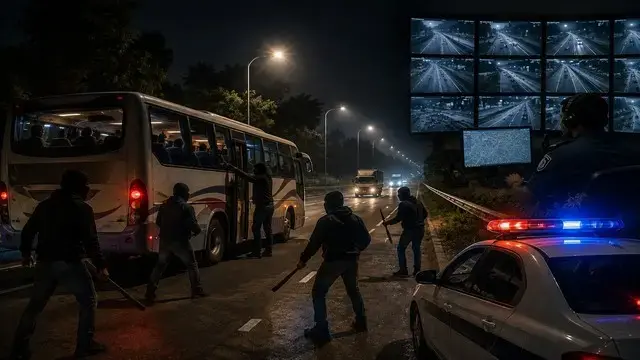
Criminals are not merely exploiting isolated roads. They are increasingly taking advantage of vulnerable stretches of highways, nighttime conditions, vehicle routes and passengers’ vulnerability
Bangladesh’s economic momentum depends heavily on its road connectivity. From transporting farmers’ produce to markets and industrial raw materials to factories, to carrying export goods to ports and enabling people to travel from one district to another, highways are directly connected to almost every aspect of economic activity. Highways, therefore, are not merely transport infrastructure; they are one of the principal foundations of the country’s economic system.
But when highways turn into zones of fear after nightfall, the issue can no longer be confined to law and order. It becomes a question of citizen security, transportation, business and trade, and ultimately the capacity of the state.
Recent developments suggest that the nature of highway crime is changing. In some places, criminals block roads by cutting down trees and forcing vehicles to stop. Elsewhere, stones and bricks are thrown at moving vehicles, while in some cases robbers board buses posing as passengers before carrying out attacks.
In other words, criminals are not merely exploiting isolated roads. They are increasingly taking advantage of vulnerable stretches of highways, nighttime conditions, vehicle routes and passengers’ vulnerability.
A Growing Pattern of Organised Highway Crime
At the beginning of 2025, police reportedly prepared a list of 1,443 identified highway robbers following incidents of organised robbery on various highways across the country. At the same time, initiatives were taken to deploy additional police personnel on different highways.
Reports of robberies involving trees being felled across roads or vehicles being forcibly stopped emerged from areas including Naogaon, Pabna and Tangail. These incidents indicate that highway crime can no longer be treated simply as a series of isolated occurrences.
The question is straightforward: as criminals change their tactics, is the security apparatus changing accordingly?
More importantly, are criminals using information to plan their attacks?
When Criminals Use Information
Highway robbery is often viewed as a sudden attack by criminals lying in wait in the darkness. But some investigations and police information suggest that certain organised groups may attempt to collect advance information about potential victims.
Vehicles carrying expatriate passengers, people transporting cash, or particular types of commercial vehicles may become targets.
This makes the situation more serious. When criminals possess not only weapons but also information about their intended targets, the crime is no longer merely opportunistic—it becomes planned and targeted.
Information such as where someone is travelling from, when they departed, how many people are inside a vehicle and whether they are likely to be carrying valuables can potentially make an attack much easier.
If such information reaches criminal networks, simply increasing police patrols may not be enough. Highway security has therefore become a battle for information as well as physical presence.
The Reality of Police Capacity
Whenever a highway robbery occurs, one question inevitably arises: Where was the police?
The question is understandable. But it is equally important to examine the capacity available to law-enforcement agencies to perform their duties.
An investigative report published in 2025 highlighted shortages in highway police manpower, vehicles and other operational capabilities. Officials also pointed to shortages of personnel and patrol vehicles compared with actual requirements. In some areas, a limited number of patrol vehicles are expected to cover extensive stretches of highway.
Two issues must therefore be addressed simultaneously.
First, police capacity must be strengthened.
Second, existing resources must be deployed in a more data-driven and risk-based manner.
It is impossible to deploy equal numbers of police officers at every point on every highway. Authorities need to analyse where the risks are highest, when crimes occur most frequently and which types of vehicles are most vulnerable.
The answer, therefore, is risk-based policing.
Cameras Are in Place—but Are They Being Used Effectively?
Bangladesh has already entered an important phase in the use of technology for highway security. In 2026, there have been developments involving the expansion of CCTV and AI-enabled surveillance systems on the Dhaka–Chattogram and Dhaka–Mawa highways. AI-based cameras are being deployed at a number of important locations.
This is undoubtedly a positive step.
But installing cameras and establishing an effective surveillance system are not the same thing.
A conventional CCTV system can preserve footage after an incident has occurred. A modern AI-enabled system, however, can potentially identify suspicious activity and issue an early warning.
For example, if several individuals suddenly bring a large object onto a highway late at night or attempt to obstruct a road, an AI-based system could detect the unusual activity and send an alert to a control room. A nearby patrol unit could then be dispatched immediately.
The desired chain should therefore be:
Camera → AI-based detection → Control room → Police alert → Rapid response
A camera alone provides surveillance. A camera linked to rapid response provides a security system.
Response Time Could Make the Difference
In highway crime, even a few minutes can be critical.
If police arrive 20 or 30 minutes after a robbery or attack, the perpetrators may already have travelled a considerable distance.
One possible solution would be to divide high-risk highways into several Rapid Response Zones. Each zone could have a designated patrol unit whose location would be monitored through GPS. Once an emergency alert is received, the nearest available unit could be dispatched immediately.
Police performance should therefore not be measured solely by the number of officers deployed.
It should also be measured by how quickly officers reach the scene after receiving an emergency alert.
Public Transport Must Become Part of the Security System
Highway security does not depend solely on what happens on the road. Security measures inside vehicles are equally important.
Long-distance buses and commercial vehicles could gradually be required to introduce:
-
GPS tracking;
-
emergency panic buttons;
-
onboard CCTV; and
-
identity verification for drivers and assistants.
Why should a driver or assistant have to make several phone calls to seek help during an emergency?
A single SOS signal should be capable of transmitting the vehicle’s location and other essential information directly to the nearest control room. Such a system could prove useful not only in cases of robbery but also during accidents, fires and other emergencies.
Darkness Is Also a Security Issue
Many stretches of Bangladesh’s highways remain poorly lit at night.
Lighting every highway may not be practical. But strategic lighting at crime-prone locations is essential.
Bridges, culverts, sharp bends, U-turns, major bus stops, isolated junctions and locations where crimes have previously occurred should receive priority.
Solar-powered smart lighting could also be introduced. This would allow critical locations to remain illuminated even where conventional electricity infrastructure is limited.
Because darkness is not merely a visibility problem for drivers. For criminals, it can also provide cover.
What Is the State Learning After Every Incident?
When a robbery occurs in Bangladesh, a case is generally filed, an investigation is launched and some suspects may be arrested.
But another important question often receives less attention:
What has changed to ensure that the same crime does not happen again?
A mandatory post-incident security review system could be introduced for serious highway crimes.
Such a review should examine:
-
How did the incident occur?
-
When did the police first learn about it?
-
How long did it take them to reach the scene?
-
What information could have helped prevent the crime?
-
What infrastructure or technological gaps existed?
-
What changes have been introduced to prevent similar incidents in the future?
Crime should not be viewed merely as a case to be investigated. Every serious incident should also become a lesson for preventing the next one.
Crime Reports Are Also a Strategic Resource
Many highway crime victims may never file a formal complaint. Some want to avoid the hassle, others lack the time, while some may lack confidence that reporting will produce results.
As a result, official statistics may fail to fully reflect the actual scale of highway crime.
A simple Digital Highway Crime Reporting System could help address this gap.
Passengers, drivers and transport operators could use mobile phones to report the location, time, vehicle registration number and nature of an incident.
Analysing this information could help authorities develop a Highway Crime Risk Map.
If implemented effectively, such a system would allow police to understand not only where crimes have occurred in the past, but also where crime patterns are emerging.
Highway Security Is Also Economic Security
The cost of highway robbery goes far beyond the loss of a mobile phone or cash.
When a cargo truck is attacked, goods can be damaged, deliveries delayed, transportation costs increased and business confidence undermined.
If concerns over nighttime security grow, transport companies may reduce nighttime operations. This could increase both the time and cost of supply chains.
For an economy like Bangladesh’s, which is increasingly dependent on manufacturing and exports, this is particularly important.
How quickly, reliably and safely a product can travel from a factory to a port is also part of the country’s competitiveness in international markets.
The security of expatriate passengers is equally important. If an expatriate returning home from an airport becomes a victim of highway crime, the damage extends beyond one family. It can also affect the country’s image.
Ten Reforms Needed to Secure Bangladesh’s Highways
A coordinated 10-point highway security reform programme could be considered.
1. National Highway Crime Risk Map
Analyse crime data from previous years and identify high-, medium- and low-risk areas.
2. Smart Highway Surveillance
Integrate CCTV with AI-based video analytics and automated vehicle number-plate recognition systems.
3. Rapid Response Units
Deploy dedicated rapid response units in high-risk areas and establish clear maximum response-time targets.
4. Highway Emergency Assistance System
Introduce GPS-linked emergency buttons on long-distance buses and commercial vehicles.
5. Eliminate Dark Spots
Ensure modern and automated lighting systems at crime-prone locations.
6. Highway Intelligence Units
Strengthen specialised intelligence units to identify organised criminal networks, their associates and the flow of information used to facilitate crimes.
7. Safer Public Transport
Expand GPS, CCTV, identity verification and emergency communication systems across buses and commercial vehicles.
8. Post-Crime Security Review
Make a mandatory security review and assessment part of the response to every serious highway crime.
9. Public Safety Data Platform
Develop integrated indicators covering crime trends, response times and investigation progress.
10. National Highway Safety Council
Establish an inter-agency highway security framework involving the police, Highway Police, Roads and Highways Department, Bangladesh Road Transport Authority (BRTA), transport-sector representatives, local administration and relevant experts.
These reforms cannot be implemented overnight.
During the first six months, authorities could focus on identifying high-risk areas and increasing patrols and rapid-response capacity. Technology could then be expanded over the following 6–18 months, followed by broader institutional reforms over 18–36 months.
The Final Word
Building highways is development. But ensuring that people can travel safely on those highways is a measure of state capacity. If criminals can turn darkness, isolation and weaknesses in information into weapons, the state must build a stronger system of prevention and response. Simply calling for more police officers is not enough.
What is required is an integrated system combining information, technology, infrastructure, rapid response and accountability. Because the real question is not simply: Why are highway robberies happening? The bigger question is:
Can an ordinary citizen safely travel home on a Bangladeshi highway at 2 a.m.?
The answer to that question will ultimately determine how developed, how secure—and above all, how capable and responsible—the state is toward its citizens.
The author is a prominent columnist, policy analyst and development professional.
Shamiur Rahman