Let Santoshpur Eco-Park Be Built—with People, Not Without Them
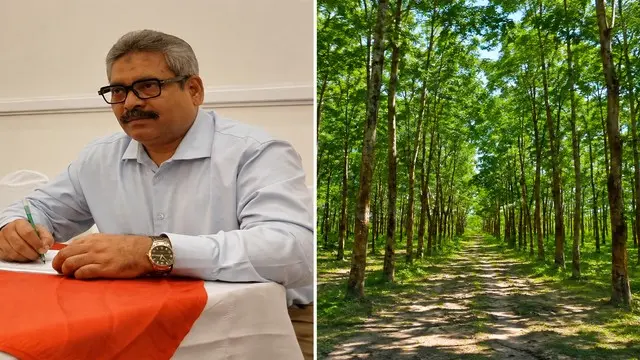
Protect the forest, preserve agriculture and livelihoods, and pursue development through harmony between nature and local communities
The government’s declaration of the reserved forestland in Santoshpur, under Naogaon Union No. 1 of Phulpur Upazila in Mymensingh, as the “Santoshpur Eco-Park” has sparked celebration and renewed hope across the area. Upazila Nirbahi Officer Shahidul Islam Sohag has confirmed to the media that the official government gazette declaring the Santoshpur Eco-Park has been received.
The long-awaited decision has generated fresh enthusiasm among local residents. Stakeholders hope the eco-park will open new opportunities for environmental conservation, tourism development, employment generation and the growth of the local economy.
According to the government gazette, approximately 565.45 acres, or 228.92 hectares, of reserved forestland in Phulpur Upazila have been designated as the Santoshpur Eco-Park. Those concerned believe the initiative can strengthen forest and biodiversity conservation while creating employment opportunities for local communities through well-planned tourism infrastructure.
As a son of Phulpur, my relationship with Santoshpur Forest is not limited to a forest alone. It is deeply connected to our nature, memories, agriculture, economy and the lives and livelihoods of local people. That is why I strongly support the development of a well-planned eco-park in Santoshpur. At the same time, I do not want families who have depended on this forest for their livelihoods for generations to be deprived in the name of development.
To me, the issue is not forest versus people. It is about protecting both the forest and the people.
An Agriculture-Friendly Eco-Park
Agriculture should not be treated as an enemy of the eco-park. Instead, environmentally sustainable agriculture can become an integral part of the Santoshpur Eco-Park model.
Existing cultivation of pineapples, turmeric, bananas and lemons can be preserved through proper planning, while farmers can be encouraged to adopt organic and low-chemical farming practices. If local agricultural products are incorporated into the branding of the eco-park, tourists themselves could become a new market for these products.
In this way, farmers would not have to lose their livelihoods to protect the forest. Rather, forest conservation could become a means of increasing their income.
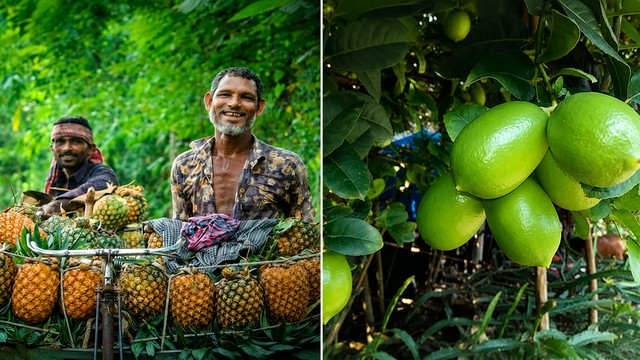
A strong local agricultural economy has developed around Santoshpur Forest over the years. Nearly 1,500 families are directly involved in social forestry and agricultural forestry programmes of the Forest Department. Around Tk 300 crore in annual economic activity is generated in the surrounding area through pineapple, turmeric, banana and lemon cultivation.
Santoshpur, therefore, is more than a forest. It is a living social and economic landscape where forests, agriculture and communities have developed through generations of mutual dependence.
The proposed eco-park can undoubtedly open a new window of opportunity. Planned tourism could stimulate the local economy, create employment, expand markets for local agricultural products and transform Santoshpur into an important nature-based tourism destination.
But an important question remains: Who will benefit from this development, and who will bear its cost?
If the construction of boundary walls, observation towers, roads, visitor centres and other infrastructure reduces agricultural land, deprives social forestry participants of access to land or forest resources, or imposes excessive restrictions on local movement and livelihoods, the project could become a symbol of deprivation rather than development. That must not happen.
Around the world, the concept of environmental conservation is evolving. Conservation is no longer simply about planting trees or declaring an area protected behind concrete walls. True conservation means bringing nature, biodiversity and human needs within an integrated management framework.
This is where Santoshpur can create a new model for Bangladesh. Before finalising the eco-park’s development plan, a comprehensive environmental and social impact assessment should be conducted. Scientific studies must determine where natural forests, social forestry areas, agricultural land, water bodies, wildlife corridors and tourism infrastructure can safely coexist.
Less Concrete, More Green
Instead of designing the project first and then attempting to fit people and nature into it, the design should emerge from the realities of the local environment and community.
Particular caution is needed regarding boundary walls. Where security is necessary, environmentally sensitive measures can be adopted. But surrounding the entire area with unnecessary concrete walls would contradict the very philosophy of an eco-park.
The same principle should apply to observation towers, roads, restaurants, shops and other structures.
The success of an eco-park should not be measured by how much concrete has been used. It should be measured by how much forest has been protected, how much biodiversity has been conserved and how much local people’s quality of life and income have improved.
Development Must Not Mean Deprivation
People involved in social forestry should not be left outside the project. They should not merely be treated as “beneficiaries”; they can become partners and guardians of the eco-park.
Local communities can be involved in forest conservation, tourism management, tour guiding, cleanliness, security, the sale of local products and environmental education programmes. This would ensure that a substantial share of the economic benefits generated by the eco-park remains within the local community.
Santoshpur can also draw inspiration from the native-species-based dense afforestation concept pioneered by Japanese botanist Akira Miyawaki. However, there is no need to copy any foreign model wholesale.
Instead, Santoshpur should develop its own environmentally sustainable model based on its native forests, soil, climate, biodiversity and traditional local knowledge.
Most importantly, no tree species should be planted in the name of social forestry if they pose a threat to local biodiversity or agriculture. Native and ecologically compatible species must receive priority.
We do not want an eco-park where forests have to be cleared to build roads simply to showcase the forest. Nor do we want tourism that damages the very nature tourists come to experience.
We want less concrete and more greenery; less encroachment and more conservation; less commercialisation and greater local participation.
New Opportunities and the Risk of Conspiracy
Phulpur has previously suffered from missed opportunities for major economic development.
During the previous government’s tenure, land was identified in Phulpur for the establishment of an economic zone or EPZ, and a high-level government monitoring team even visited the site. However, at the final stage, the EPZ was reportedly shifted from Phulpur to Jamalpur because of what local residents describe as a conspiracy by vested interests.
As a result, the people of Phulpur were deprived of a significant development opportunity.
Against the backdrop of that bitter experience, some local residents now fear similar attempts to obstruct the Santoshpur Eco-Park project.
According to local concerns, a powerful group has long been illegally occupying parts of the forestland designated for the eco-park. There are allegations that vested interests are attempting to mislead ordinary and vulnerable people and mobilise them through human chains and protests in an effort to obstruct the development initiative.
Such attempts, if established, must be resisted through lawful and transparent measures. All stakeholders should work together to ensure that the eco-park is implemented in a manner that protects both the forest and the legitimate interests of local communities.
A Model Built on Local Realities
The future planning of Santoshpur must ensure the meaningful participation of local farmers, social forestry beneficiaries, the Forest Department, environmental experts, local administration, elected representatives and ordinary residents.
Listening to their views should not be treated as a mere formality. It is one of the key conditions for the project’s long-term success.
As a son of Phulpur, my expectation is simple and clear: I want an eco-park in Santoshpur. But I do not want it to be built at the expense of Santoshpur’s people and their livelihoods.
I want the forest to be protected, but I do not want people’s lives and livelihoods to be destroyed in the name of protecting the forest.
Santoshpur now has a rare opportunity. If properly planned, it can become a model where forests remain protected, farmers continue to thrive, biodiversity is conserved, tourism flourishes and local incomes increase.
Therefore, the debate should not be reduced to the simplistic question of whether an eco-park should be established. The real question should be:
How can we build an eco-park where both the forest and the people emerge as winners?
Let Santoshpur Eco-Park be built. But not without its people—rather, with its people.
Let development take place—but not at the expense of nature.
Let conservation prevail—but not at the cost of livelihoods.
Let Santoshpur become a model where protecting nature and improving people’s lives are not competing goals, but two inseparable parts of the same future.
The author is a prominent columnist, policy analyst and development professional.
Shamiur Rahman