A courageous decision by govt
Administration needs complete overhaul
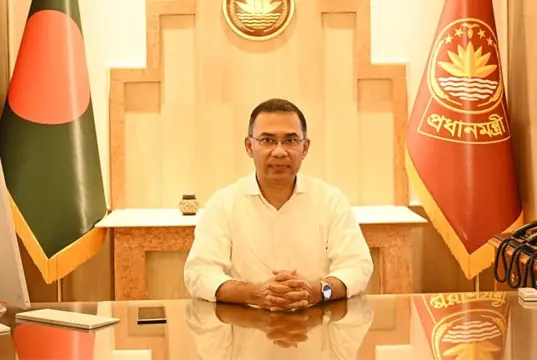
Exactly 46 years later, following the path shown by Shaheed President Ziaur Rahman, his successor, Prime Minister Tarique Rahman, has taken another bold decision
Bangladesh, the first Self-Reliant Village Government (Swanirbhar Gram Sarkar) was officially established on 30 April 1980 in Jirabo village, Savar. By introducing the “Gram Sarkar”, Shaheed President Ziaur Rahman took what many regarded as a historic and courageous decision.
When journalists asked whether the move was overly bold, Zia reportedly replied that one must be courageous if one truly wishes to serve the people. Exactly 46 years later, following the path shown by Shaheed President Ziaur Rahman, his successor, Prime Minister Tarique Rahman, has taken another bold decision.
The government has appointed leaders from the ruling BNP and its associate organisations to the top positions of 11 public institutions on one-year contractual terms. Significantly, these individuals have been entrusted with organisations that have considerable potential to contribute to the country's socio-economic development and poverty reduction.
However, these posts have long been regarded by bureaucrats as "dumping posts". Many officials consider them punitive transfers and, as a result, are reluctant to take meaningful initiatives after assuming office. Consequently, these important institutions have remained largely ineffective, failing to fulfil the purposes for which they were established.
Take the Forest Industries Development Corporation, for example. It has the potential to make a significant contribution to the national economy through the development of forest resources and forest-based industries. Yet, owing to a lack of capable leadership, little progress has been made in this promising sector. The Prime Minister has now made a political appointment to lead the organisation.
Similar appointments have also been made to key institutions, including the Bangladesh Inland Water Transport Corporation (BIWTC), Bangladesh Climate Change Trust, Bangladesh Handloom Board, Bangladesh Jute Corporation, Shramik Kalyan Foundation, Bangladesh Overseas Employment and Services Limited (BOESL), National Social Welfare Council, Bangladesh Steel and Engineering Corporation (BSEC), Bangladesh Sugar and Food Industries Corporation (BSFIC), and Bangladesh Small and Cottage Industries Corporation (BSCIC).
Given their mandates, these organisations have the capacity to reshape the national economy if they function effectively. Their active participation could make a significant contribution to GDP. Yet, because of bureaucratic neglect and indifference, many remain ineffective, while losses in organisations such as the sugar industry and the Jute Corporation continue to mount.
This demonstrates the Prime Minister's foresight. He has identified these eleven organisations as a starting point and entrusted them to individuals who, it is argued, will discharge their responsibilities in line with political experience, party programmes and the government's policy agenda. In pursuing their political careers, these appointees are expected to work towards revitalising these dormant public bodies. Such efforts could stimulate economic growth while reducing wasteful government expenditure – precisely what a political government is expected to achieve.
A similarly bold transformation is needed across the administration, law enforcement agencies and the judiciary. No government can implement its vision without the full cooperation of every branch of the state. For this reason, in many democratic countries, an incoming political administration reshapes the bureaucracy, judiciary and law enforcement agencies to ensure that every level of government contributes effectively to achieving its objectives.
A government is not merely its cabinet; from the Prime Minister to an Upazila Nirbahi Officer (UNO), every official forms part of the state machinery. Just as a military parade fails if everyone does not march in step, a government cannot function dynamically or successfully unless every tier of its structure works together in harmony.
Consider, for instance, the government's proposed Farmer Card programme. If field-level officials fail to prepare an accurate list of farmers, this initiative cannot be implemented successfully. The inefficiency of only a handful of deputy commissioners (DCs) or UNOs could derail the entire project. Likewise, if law enforcement agencies fail to perform their duties properly, opportunities for fraud involving the cards will increase.
Moreover, there is an increasing tendency to take almost every issue to court. If someone challenges the legality of issuing Farmer Cards and the case comes before a judge opposed to the initiative, a single ruling could halt the programme. If the judiciary becomes hostile for any reason, it can create obstacles to government action at every stage. As a result, fulfilling electoral commitments becomes more difficult, and the pace of governance inevitably slows. A political government can succeed only when all parts of the state apparatus function in unison.
A democratic government may be compared to the human body. Just as the body cannot function properly unless all its organs work together – and even the failure of a single organ can affect the whole system – a government cannot succeed unless all its constituent parts operate effectively. This is a fundamental principle of statecraft.
For this reason, it is argued that, in many developed democracies, personnel across state institutions change following a change of government. In the United States, a new administration appoints trusted officials to senior positions throughout government, including the administration, law enforcement and intelligence agencies. Similar practices exist in the United Kingdom. In India, too, changes in government are often accompanied by changes within sections of the administration, law enforcement and other public institutions. This is presented as a feature of modern governance. There was a time when governments changed while the administration and law enforcement agencies remained entirely neutral, but proponents argue that this doctrine has largely faded in contemporary political systems.
The primary accountability of any government is to the people. An electoral manifesto represents the contract between an elected government and the electorate. Delivering on those commitments is therefore its foremost responsibility, and failure to do so is widely regarded as a sign of unsuccessful governance. To achieve its objectives, a government may believe that it must comprehensively restructure the state machinery.
In the 12 February election, the BNP secured a two-thirds majority, leading to the formation of a new cabinet under Prime Minister Tarique Rahman. Since taking office, he has sought to implement the BNP's electoral manifesto. Over the past five months, several reshuffles have taken place within the higher ranks of the administration and law enforcement agencies, alongside reported changes at the field level.
However, supporters of the government's approach argue that these measures remain insufficient. They contend that many officials within the administration remain opposed to the BNP's political ideology and actively worked against the party during the last election. Although some may now present themselves as loyal followers of the late President Ziaur Rahman, they are believed to be waiting for opportunities to undermine the BNP.
On 8 August 2024, three days after the fall of the Awami League government on 5 August, an interim administration led by Dr Yunus assumed office. Upon taking power, it carried out extensive changes across the state apparatus. Reshuffles took place from the Chief Justice to lower court judges, from the Cabinet Secretary to Assistant Secretaries, and from the Inspector General of Police (IGP) to local Officers-in-Charge (OCs). According to critics, the primary objective of the Yunus administration was to consolidate its position over the long term by placing individuals favourable to its agenda in key posts while sidelining those who supported an early election.
It is further alleged that these reshuffles were based on recommendations from two specific political parties. During this period, leaders of the Anti-Discrimination Student Movement reportedly maintained a presence in the Secretariat and influenced appointments according to their preferences. Allegations also emerged that some advisers approved postings – from DCs to Secretaries – in exchange for substantial sums of money. Reports of appointments being secured through financial transactions became widespread during the Yunus administration. Although newspapers published reports on these allegations, critics argue that the interim government failed to act decisively, relying instead on token inquiry committees. Consequently, questions continue to be raised about the integrity and competence of many of those appointed during that period.
The Ministry of Law and Justice, under Asif Nazrul, has been described by critics as the most controversial ministry during the Yunus administration. They allege that judicial appointments to the lower courts were made arbitrarily and that many involved financial transactions. Further allegations suggest that legal procedures were violated and corruption occurred in the appointment of law officers. Critics also claim that an excessive number of law officers were appointed to the Attorney General's Office to satisfy particular interests. The appointment of government prosecutors in lower courts has likewise been criticised as poorly managed. Complaints have reportedly been submitted to the Anti-Corruption Commission alleging that Asif Nazrul embezzled hundreds of crores of taka through appointment and transfer rackets. However, no action has yet been taken. More significantly, despite more than five months having passed since the BNP assumed office, many of these controversial appointees remain in their positions.
The current government, elected with what it describes as a strong public mandate, believes that an elected administration cannot function effectively through a bureaucracy established by an unelected regime. It further argues that the Yunus administration designed this framework to delay elections and prolong its own tenure. Yunus himself reportedly stated that many people wanted him to remain in office for another 50 years. Critics cite both these remarks and the actions of his advisers as evidence that the interim administration had little intention of holding elections and did so only under pressure. They also argue that the Yunus government pursued a depoliticisation agenda similar to that seen during the 1/11 period, but that this was ultimately thwarted by the leadership of Tarique Rahman.
Supporters of the current government therefore argue that the administration, judiciary and law enforcement agencies organised by the interim government are not aligned with the BNP and may instead seek opportunities to undermine the party's popularity. They also contend that many of the key figures associated with the events of 1/11 remain active and are waiting for another opportunity.
To counter these perceived challenges and ensure the success of the present administration, proponents argue that further decisive action is necessary – similar to the prime minister's recent appointments to the eleven public institutions. By comprehensively restructuring the machinery of government in line with its political commitments, they believe the prime minister can place his administration on a stronger path towards achieving its objectives.
Shamiur Rahman