63 Years of WASA, Yet Reliable Water Remains a Question
Dhaka’s Water Dilemma: Supply on Paper, Shortage at Home
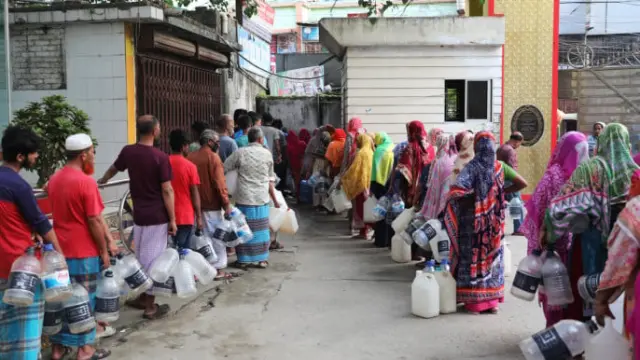
Ensuring a reliable water supply is therefore not simply a matter of convenience. It is one of the fundamental responsibilities of the state and urban authorities
Water is not merely a civic utility. It is directly connected to people’s health, hygiene, sanitation and dignity. Cooking, bathing, washing clothes and dishes, and using toilets—all depend on a reliable water supply. When water supply is disrupted, therefore, normal life is disrupted as well.
The problem becomes even more serious in a densely populated city like Dhaka. When water stops flowing in a high-rise building, inconvenience can turn into a serious crisis within hours. The issue is no longer limited to water; it affects health, sanitation and the quality of urban life.
The question, therefore, is straightforward: If there is LPG when gas is unavailable, and IPS systems, generators or solar power when electricity fails, what is the alternative when there is no water?
Dhaka Grows, Water Demand Soars
Dhaka WASA was established on November 7, 1963. At that time, Dhaka had an estimated population of around 8.5 million. Daily demand for water was approximately 150 million litres, while supply capacity was around 130 million litres.
More than six decades later, Dhaka has changed dramatically. The population has grown, high-rise buildings have spread across the city, and residential and commercial development has expanded rapidly. As a result, demand for water has increased many times over.
According to the information provided for this report, daily water demand in the Dhaka North and Dhaka South city corporation areas in 2026 stands at around 3.2 to 3.25 billion litres.
The city’s water infrastructure has also expanded. But increasing production capacity alone cannot solve the problem.
Water produced at a treatment plant still has to reach consumers through transmission lines, pumping stations, reservoirs and distribution networks. If water pressure is inadequate, pipelines malfunction or the distribution system is unable to cope with demand, consumers may remain without water even when sufficient water has been produced.
Produced Water, Missing Supply
Dhaka WASA’s water supply network stretches for around 5,100 kilometres. The system also includes water treatment plants, overhead tanks and more than a thousand deep tube wells.
The expansion of infrastructure is undoubtedly important. But the quality of water service is ultimately measured somewhere else.
Does water actually come out when residents turn on the tap?
A high-rise building may have water on its lower floors while residents on upper floors receive little or none. A drop in water pressure can create such a situation. As a result, an area may technically have water supply according to official records, while many residents experience something completely different.
That is why measuring water supply only in terms of production is not enough.
Authorities need to know how much water is being produced, how much is being distributed, where shortages are occurring and how much water ultimately reaches consumers.
Water shortages have recently caused serious hardship in several areas of Mirpur. Reports have emerged of prolonged shortages in Shewrapara, Kazipara, Monipur and surrounding areas. In some places, residents have reportedly gone without water for extended periods, forcing them to purchase water or depend on tankers.
Such a crisis is not simply about a shortage of water. It is a crisis of everyday life.
When water is unavailable, bathrooms become difficult to use, toilets become harder to keep clean, bathing is disrupted, dishes accumulate in kitchens, clothes cannot be washed properly, and caring for children and elderly people becomes more difficult.
In other words, a disruption in water supply immediately puts household hygiene and sanitation at risk.
It also affects something less visible but equally important: human dignity.
Can Tankers Be a Solution?
Water tankers may be necessary during emergencies. But they cannot be a sustainable alternative to a reliable water supply in a major metropolitan city.
Consider a high-rise building housing more than 100 families. Supplying their daily water requirements through tankers would require a large number of vehicles, repeated deliveries and substantial additional costs.
The bigger question is whether every household can afford those costs.
This is where a water crisis can become a matter of social inequality. Those who can afford it can buy water. Those who cannot may have no choice but to wait.
Should access to a basic civic service ultimately depend on a person’s purchasing power?
Gas Has Alternatives. Electricity Has Options. What About Water?
When gas is unavailable, households can turn to LPG cylinders. When electricity fails, people can use IPS systems, generators or solar power.
But what can an ordinary family do when there is no water?
Bottled water can be purchased for drinking. But can bottled water meet the daily needs of bathing, washing clothes, cleaning kitchens and maintaining sanitation in a high-rise building? It cannot.
That is what makes water fundamentally different from many other utilities. A household cannot create a complete alternative water supply system on its own.
Ensuring a reliable water supply is therefore not simply a matter of convenience. It is one of the fundamental responsibilities of the state and urban authorities.
Suffering Without Accountability?
Citizens pay their water bills. Action can be taken when bills remain unpaid.
But who keeps track of the days when citizens do not receive the service they have paid for?
If a working person has to spend additional hours every day collecting water, if a homemaker has to devote hours to securing water, or if a family has to purchase water regularly, who bears the cost of that additional time and expense?
Citizens should have the right to know:
-
How many hours of water supply are available in each area?
-
Where is water pressure low?
-
Where have pipelines failed?
-
When will repairs be completed?
-
Where are emergency water tankers available?
-
What is the authority’s response time when an area remains without water for an extended period?
Making such information easily accessible would not only reduce public uncertainty but also strengthen institutional accountability.
Build Less, Manage Better
Dhaka WASA has invested in water treatment plants, deep tube wells and pipelines over the decades. Initiatives have also been taken to increase the use of surface water.
However, the success of a city’s water supply system cannot be measured simply by the number of projects completed, kilometres of pipelines installed or litres of water produced.
It must ultimately be measured by the experience of citizens.
A modern water supply system requires not only adequate production capacity but also a reliable distribution network, effective pressure management, regular pipeline maintenance, lower leakage and system losses, demand assessments for high-rise buildings and rapid emergency water-supply mechanisms.
At the same time, citizens need regular and accurate information about the situation.
No Escape from Accountability
Dhaka WASA is 63 years old. During this period, the city has changed dramatically. Its population has grown, urbanisation has accelerated, high-rise buildings have multiplied and demand for water has increased.
The water supply system must therefore evolve accordingly—becoming more modern, reliable and accountable.
Citizens are required to pay their bills, follow regulations and face penalties for violating rules. Service providers, too, must explain why they fail to deliver essential services.
The questions from citizens are simple:
I paid my bill—where is the water?
I followed the rules—where is the service?
I waited—where is the solution?
I had to buy water—who is responsible for the additional cost?
The Bottom Line
Solving Dhaka’s water crisis is not simply about producing more water. It requires a comprehensive review of the entire system, from production to distribution.
Authorities need long-term planning based on demand, supply gaps, water pressure, ageing pipelines and infrastructure requirements.
Most importantly, citizens need accurate information and timely action during crises.
A citizen does not drink Dhaka WASA’s annual report. Nor does a resident consume production statistics.
They simply want water when they turn on the tap.
When a tap remains dry day after day, it is not merely a household inconvenience. It becomes a larger question about the quality of urban governance and the reliability of essential public services.
There may be an alternative to gas. There may be alternatives to electricity. But there is no real substitute for water. Ensuring reliable access to water is not an act of generosity—it is a fundamental responsibility of public service.
Shamiur Rahman