
- National /
- Liberation war veteran AK Khandker passes away

Shamiur Rahman Lipu
Published:2025-12-20 21:36:43 BdST
CA expresses condolencesLiberation war veteran AK Khandker passes away
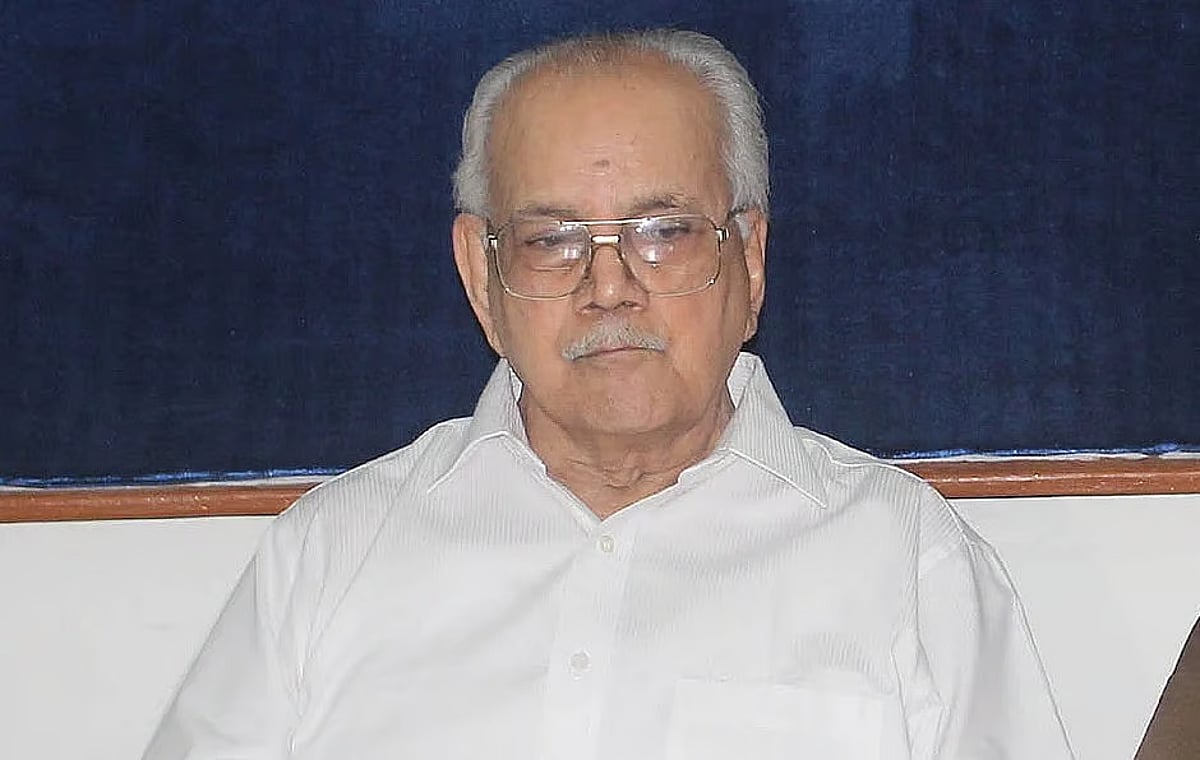
Bir Uttam–awardee valiant freedom fighter and country’s first Air Force Chief Abdul Karim Khandker, popularly known as AK Khandker passed away in Dhaka on Saturday.
He breathed his last at 10:35am in Combined Military Hospital (CMH) due to age-related complications. He was 95. He is survived by his wife, two sons and a daughter.
He had been suffering from multiple ailments for several years and was admitted to CMH on December 7 as his condition deteriorated.
Inter-Services Public Relations (ISPR) confirmed this to media by a press note issued early in the morning.
His namaz-e-janaza will be held tomorrow after Zuhr prayers at Bangladesh Air Force Base Bashar in Dhaka Cantonment. Following the janaza and state honours, he will be buried at the military graveyard.
CA expresses condolences
Chief Adviser Prof Muhammad Yunus has expressed deep sorrow and condolences at the death of Bir Uttam former minister Air Vice Marshal (retd) Abdul Karim Khandker (AK Khandker).
In a condolence message, the chief adviser said AK Khandker was an unforgettable soldier of Bangladesh’s struggle for independence. His death marks the loss of a prominent figure in Bangladesh’s military and national history.
He prayed for the departed soul, extending sympathy to the bereaved family, fellow freedom fighters and admirers.
Early life
Abdul Karim Khandker was born under the rule of the British Raj on 31 October 1930 in Rangpur. His ancestral home was in Bera upazila of Pabna.
AK Khandaker was belongs to respected Khandaker family of Pabna town. His father was Abdul Lateef Khandker and his mother was Arefa Khatun.
He completed his matriculation in 1947 and ISC in 1949. He Completed his graduation from PAF College in September 1952 and PSA in 1965 from Pakistan Air Force Staff College.
Military Career
Air Vice Marshal (Retd.) Khandker was a highly decorated military personal. He joined the Pakistan Air Force in 1949. He started his service career as GD Pilot in January 1951. He was commissioned in Pakistan Air Force in September 1952.
AK Khandker served in Fighter Squadron till 1955 and became Flying Instructor. He was at PAF Academy till 1957 as flying instructor. He served as Flight Commander at Flying Instructors' School till 1958.
Later he became Flight Commander at Jet Fighter Conversion Squadron where he served till 1960. He was promoted to the rank of Squadron leader in 1960.
Khandker was Squadron Commander at Pakistan Air Force Academy till 1961. Afterwards, he became Squadron Commander of Jet Fighter Conversion Squadron where he served till 1965.
He served as Officer Commanding of Training wing at PAF Academy in 1966. He became PSA in 1965 from Pakistan Air Force Staff College. In 1966 he was promoted to the rank of Wing commander.
A K Khandker was the President of PAF Planning Board from 1966 to 1969. Later, he was posted at Dhaka as Second in Command of PAF Base in 1969. In December 1969 he was promoted to the rank of Group captain.
Liberation War
During the 1971 Liberation War, he played a crucial role in achieving independence through his courage, foresight and leadership.
One of the key organisers of the Liberation War, Air Vice Marshal (Retd.) Khandker was serving as a group captain of the Pakistan Air Force at Dhaka Cantonment in March 1971.
On May 15, 1971, Khandker crossed into India with Wing Commander M. K. Bashar, several other pilots and fellow officers, reaching Agartala in Tripura.
The following day, he met Liberation Army chief Col Ataul Gani Osmani and members of the government-in-exile, after which he was assigned the responsibility of deputy commander of the Liberation War.
As deputy chief of staff of the Mukti Bahini; his strategic decisions, organisational skills and unwavering patriotism significantly strengthened the liberation struggle.
He closely interacted with the senior officials of the Indian Eastern Command located at Fort William, Kolkata about training strategies for the Freedom Fighters as well as for overall operation. He established the first ever Bangladesh Air Force in Dimapur, Nagaland during the war.
The Bangladesh Air Force with its limited manpower and resources of only 09 officers, 57 airmen, and 03 aircraft carried out significant numbers of operation against the Pakistani invaders. He was the coordinator of Operation Kilo Flight in late August 1971.
In the absence of Col Osmani, he represented Bangladesh at the December 16, 1971 ceremony in Dhaka when Pakistani troops led by Lieutenant General AAK Niazi surrendered to the India-Bangladesh joint forces led by India’s Lieutenant General Jagjit Singh Aurora.
Late, he remained active in public life, serving the nation in various capacities.
Post liberation war
After independence, AK Khandker played a pioneering role in building the Bangladesh Air Force. Within next two years, he assembled a fighter squadron, a helicopter squadron, and 2 radar units to its strength.
He served the Bangladesh Air Force as its Chief during the period 1972–1975. During this tenure, he made outstanding contributions to establishing Bangladesh Air Force as a well-organised and effective force.
Diplomatic Career
Apart from serving the Bangladesh Air Force, he was the first Chairman of the national carrier Bangladesh Biman for the period 1972–1973.
In the following years, AK Khandaker began his diplomatic career to represent Bangladesh in the international arena.
AK Khandker was appointed as the Bangladesh High Commissioner in Australia during the military rule of late president Ziaur Rahman. He served the mission during 1976–1982.
Later on, he became the Bangladesh High Commissioner in India for the period 1982–1986.
Political journey
In 1986, he was appointed as Adviser to the then President Hussain Muhammad Ershad and thereafter he served the nation as the Planning Minister up to 1990.
He was elected as a member of parliament on Awami League ticket in 1998 and 2009 from the Pabna-2 constituency (Sujanagar Upazila).
In 2009, he had been inducted as a full cabinet minister and given the charge of the Minister, Ministry of Planning.
He was regarded a key-figure in establishing in 2007 the 'Sector Commanders Forum' by organising Liberation War time sector and sub-sector commanders to wage a campaign to offset forces which were opposed to Bangladesh’s independence in 1971.
Awards
AK Khandker received the gallantry award of 'Bir Uttom' in 1972 for his luminous role in the Liberation War.[
In recognition of his contributions to the Liberation War, the government awarded him the Independence Award in 2011, the country's highest civilian honour.
Later, BAF Base Bir Uttom A. K. Khandker was named after him in 2025.
Controversy
In 2014, Khandker published a book titled "1971: Bhitore Baire" (1971: Inside and Outside), which sparked controversy for including disputed information about Bangabandhu Sheikh Mujibur Rahman.
An uproar in parliament ensued where Awami League lawmakers demanded that the book must be banned and its copies will be confiscated. They also demanded filing a sedition case against the writer, who is also a sector commander of the liberation war.
In response, Khandaker resigned from the Sector Commanders Forum. He was then declared a persona non grata in the district of Gazipur and pro-government lawyers demanded withdrawal of all of his titles.
As a result of the uproar, he later retracted a section of the book and publicly apologised to the nation and to the memory of Bangabandhu on 11 August 2019.
AK Khandker was a resolute freedom fighter, honest, courageous and a principled patriot whose work, thoughts, and ideals will continue to inspire future generations.
The nation has lost a heroic son with his passing. AK Khandker will always remembered for his leadership and outstanding contribution to the country’s independence.
Unauthorized use or reproduction of The Finance Today content for commercial purposes is strictly prohibited.