NEW GOVT DECISIONS ON FOREIGN PORT DEALS
Laldiar container terminal deal with Danish co stays
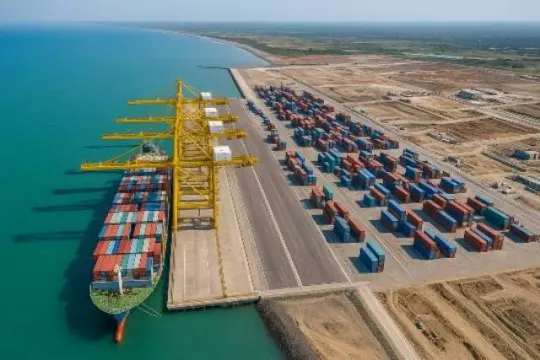
Responding to a written question from lawmaker Md. Shahadat Hossain from Lakshmipur-1 during the parliamentary question-and-answer session Monday, minister Shaikh Robiul Alam made it clear that the deal was concluded through a "transparent process" under the government-to-government (G2G) framework between Bangladesh and Denmark, "in full compliance with the Public-Private Partnership (PPP) Act an
The government has no plans to cancel or renegotiate the concession agreement with Denmark-based APM Terminals for the construction and operation of the Laldiarchar Container Terminal at Chattogram seaport, Shipping Minister Shaikh Robiul Alam confirmed.
Responding to a written question from lawmaker Md. Shahadat Hossain (Lakshmipur-1) during a parliamentary session on Monday, the minister clarified that the deal was finalized through a highly transparent process under a government-to-government (G2G) framework. He emphasized that the agreement strictly complies with the Public-Private Partnership (PPP) Act and all relevant national regulations.
Timeline of the Laldiarchar Project
The minister detailed the step-by-step progression of the massive infrastructure project:
June 30, 2021: Bangladesh and Denmark signed a Memorandum of Understanding (MoU) to promote environmentally sustainable infrastructure.
May 21, 2023: APM Terminals, a subsidiary of the global shipping giant Maersk Group, formally proposed building the container terminal on the right bank of the Karnaphuli River at Laldiarchar.
November 29, 2023: The Cabinet Committee on Economic Affairs granted in-principle approval.
January 3, 2024: The Danish government formally endorsed APM Terminals during the first Bangladesh-Denmark PPP Joint Platform meeting.
November 17, 2025: Following comprehensive due diligence and legal reviews by the International Finance Corporation (IFC) acting as transaction adviser, the Chattogram Port Authority and APMT BV signed the official concession agreement.
Under the agreement, APM Terminals will invest US$550 million to develop the state-of-the-art terminal on vacant land within the Chattogram Port area. The project is expected to dramatically boost the port’s container-handling capacity, create local employment, and facilitate the transfer of advanced maritime technologies to Bangladesh.
Matarbari Deep-Sea Port Set for 2029 Launch
In response to another query from lawmaker Md. Nurul Islam (Chapainawabganj-3), Minister Alam shared key updates on the Japan-sponsored Matarbari Deep-sea Port, calling it a historic milestone for the nation's maritime trade.
The deep-sea port is projected to become fully operational by 2029. For the first time in its history, Bangladesh will be equipped to directly accommodate:
Container mother vessels with capacities of approximately 8,200 TEUs (twenty-foot equivalent units).
Cargo ships of up to 100,000 DWT (deadweight tonnes).
"This will allow vessels with nearly four times the carrying capacity of those currently handled at Chattogram Port to berth directly, bringing a transformative change in the country's import and export trade," the minister told parliament.
Economic Implications
Due to draft limitations at existing domestic seaports, Bangladeshi importers currently rely on regional transshipment hubs—primarily Singapore, Colombo, and Malaysian ports—where mother vessel cargo must be cross-loaded onto smaller feeder ships. This multi-stage supply chain inflates both freight logistics costs and transit durations.
Featuring a designed navigation channel depth of approximately 16 meters, the Matarbari facility is engineered to mitigate foreign transshipment dependency. The Ministry expects the operationalized port to lower overall logistics overheads, accelerate supply chain turnaround times, and position Bangladesh as a competitive transit and logistics hub for neighboring South Asian economies.
Shamiur Rahman