Corruption Allegations Cast Shadows
Inside Dhaka's Customs Bond Scandal
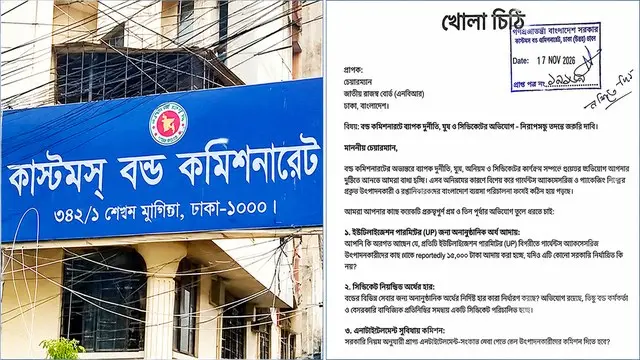
Businesses allege a syndicate is extracting unofficial payments for routine services, while questions mount over officials' wealth and lack of transparency
A government agency entrusted with facilitating export-oriented industries is facing serious allegations of corruption, bribery and institutional misconduct, with business representatives claiming that access to routine services has increasingly become dependent on unofficial payments.
The Dhaka Customs Bond Commissionerate, operating under the National Board of Revenue (NBR), has come under scrutiny following allegations that a network involving officials, employees and private-sector intermediaries is running an informal system of financial transactions in exchange for administrative services.
Entrepreneurs in the garment packaging and accessories manufacturing sector allege that businesses are being charged thousands to lakhs of taka beyond prescribed government fees for services such as Utilisation Permission (UP), bond licence renewals and entitlement facilities.
The allegations, detailed in a written complaint submitted to the NBR chairman on November 17, 2026, raise fundamental questions about the integrity of an institution that plays an important role in facilitating Bangladesh's export trade.
Copies of the complaint were also sent to the Prime Minister, the finance secretary, the commerce secretary and the relevant NBR member.
At the centre of the allegations is an apparent system in which businesses seeking routine administrative approvals are allegedly compelled to navigate unofficial financial arrangements.
A Price Tag on Every Approval?
One of the most specific allegations concerns Utilisation Permission (UP), a key authorisation required by businesses operating under the bonded warehouse facility.
According to the complaint, garment accessories manufacturers are allegedly being charged around Tk15,000 for each UP, despite questions over whether such a payment is authorised under the government's prescribed fee structure.
The complainants have demanded an investigation into who collects the money, how the transactions are conducted and where the funds are ultimately deposited.
Licence renewals present another area of concern. The complaint alleges that businesses are being asked to pay between Tk50,000 and Tk10 lakh, depending on the circumstances, to renew their bond licences.
If verified, such collections would raise serious concerns about the misuse of administrative authority and the integrity of public service delivery.
The complaint further alleges that an informal commission-based network has emerged around different bond-related services, involving certain officials and representatives of private commercial entities.
Business representatives want investigators to establish whether intermediaries are influencing administrative decisions, who benefits financially and whether senior officials are involved in facilitating the alleged arrangements.
The Hidden Power Brokers Behind Customs Bond
The allegations also point to financial transactions involving private companies' compliance officers and the personal assistants of Revenue Officers (ROs), Assistant Revenue Officers (AROs) and senior officials.
According to the complaint, payments are allegedly made under the pretext of document preparation, typing and settling various service-related fees.
The complainants have called for scrutiny of these transactions to determine whether they are being used to secure preferential treatment or other improper benefits.
Such allegations, if substantiated, would suggest that unofficial financial dealings may have extended beyond individual transactions into the administrative process itself.
However, the identities and specific roles of those allegedly involved, as well as documentary evidence establishing the transactions, require independent verification.
No Bribe, No Service
Perhaps more troubling is the allegation that businesses unwilling to make unofficial payments face administrative delays, complications and harassment.
According to the entrepreneurs, some businesses allegedly receive services more easily by agreeing to make additional payments, while those insisting on following official procedures encounter obstacles.
This raises concerns about unequal treatment within an industry that is already struggling with rising production costs, higher energy prices, workers' wages, expensive raw materials, interest rates and administrative expenses.
The complainants warn that continued harassment and alleged financial exploitation could undermine investment, disrupt production and place additional pressure on businesses already operating under difficult economic conditions.
For export-oriented manufacturers, predictable and transparent access to government services is essential. An informal payment system, if established, could therefore have consequences extending beyond individual companies to the wider export supply chain.
Officials' wealth raises further questions
The complaint also raises questions about the wealth and lifestyles of certain officials of the Bond Commissionerate.
It alleges that some officials receiving monthly government salaries of between Tk50,000 and Tk90,000 maintain lifestyles that appear disproportionate to their declared earnings.
Questions have also been raised about the alleged expenditure on their children's overseas higher education and other costly commitments.
The entrepreneurs have called for an examination of the relevant officials' income tax returns, asset declarations, bank accounts and financial transactions to determine whether their wealth is consistent with their legitimate sources of income.
These allegations have not, by themselves, established any wrongdoing. But they warrant scrutiny by the appropriate authorities if supported by verifiable financial records.
Blocking the Press, Shielding the Truth?
The controversy has taken another dimension with allegations that journalists investigating the matter have faced obstruction and a lack of cooperation from relevant officials.
Attempts to obtain information and responses concerning the alleged irregularities have reportedly encountered resistance.
The issue raises a broader question about transparency in public institutions. When allegations of corruption involve a government agency, access to relevant information and the opportunity to obtain responses from those concerned are essential to establishing the facts.
An institution's failure to provide meaningful answers does not establish guilt. However, withholding relevant information or obstructing legitimate journalistic inquiries can further undermine public confidence.
The authorities must therefore clarify their position and provide evidence-based responses to the allegations.
Calls for an independent probe
The complainants have proposed the formation of an independent monitoring cell or investigation committee comprising government representatives, genuine businesspeople and independent professionals.
They have called for a comprehensive investigation into alleged unofficial collections, commission trading, financial transactions and abuse of administrative authority.
Their recommendations include:
Publicly displaying officially approved fees for UP, entitlement and licence renewal services.
Ending unofficial financial transactions and unnecessary personal dealings between businesses and officials.
Digitising all bond-related services and introducing fixed deadlines for processing applications.
Establishing a confidential mechanism for reporting corruption and protecting complainants from retaliation.
Auditing financial transactions and examining the assets and income declarations of officials where evidence warrants scrutiny.
They have also demanded departmental and legal action against anyone found responsible for misconduct following an impartial investigation.
NBR faces a test of credibility
The allegations against the Dhaka Customs Bond Commissionerate present a significant test for the NBR, which is responsible for ensuring transparency, compliance and accountability across the country's revenue administration.
The issue is not simply whether individual businesses have been asked to pay additional money. It is whether a public institution responsible for facilitating legitimate trade has allowed an informal system of payments and influence to take root.
If the allegations are substantiated, those responsible must be held accountable under the law. If they are unfounded, the authorities should establish that through a transparent investigation supported by documentary evidence.
The NBR should also ensure that the complainants and journalists seeking to establish the facts are not subjected to intimidation or retaliation.
For Bangladesh's export-oriented industries, the credibility of the bond management system is directly linked to business confidence, investment and the country's competitiveness.
The question now is whether the NBR will investigate the allegations independently and transparently—or whether the complaint will become another document lost in the corridors of bureaucracy.
Shamiur Rahman