Toll hits 54 as flood-hit people battle hunger, snakebites
Disaster management and relief ministry figures show 31 of the deaths occurred in Cox’s Bazar, 13 in Chattogram, six in Bandarban, three in Rangamati and one in Moulvibazar.
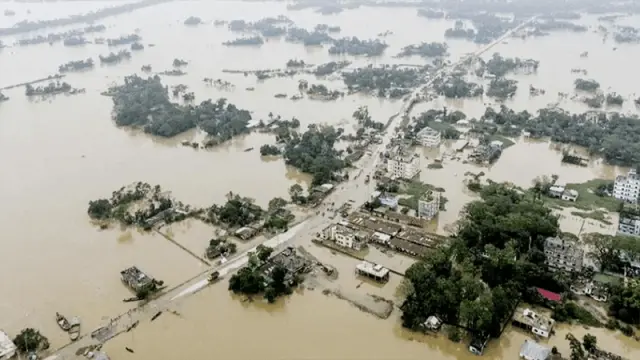
The flood and landslide death toll in the country climbed to 54 on Monday, with more than 609,000 people affected, as receding waters on the sixth day of the disaster exposed a fresh crisis: entire communities left without food, safe drinking water or medicine, and a surge in snakebites sweeping through the worst-hit districts.
Disaster management and relief ministry figures show 31 of the deaths occurred in Cox’s Bazar, 13 in Chattogram, six in Bandarban, three in Rangamati and one in Moulvibazar.
Seven districts in all have been battered by the disaster: Khagrachhari, Rangamati, Bandarban, Cox’s Bazar, Chattogram, Moulvibazar and Habiganj.
The ministry’s latest situation report puts the scale of the devastation in stark terms: 59 upazilas, 334 unions and 12 municipalities inundated, 155,311 families marooned, and 609,411 people affected in total. A further 39 people were injured, including 24 in Cox’s Bazar, 12 in Chattogram, two in Bandarban and one in Khagrachhari.
Some 1,049 shelter centres have been opened to house the displaced, with 38,422 people currently taking refuge in them.
The government, alongside local administrations, the armed forces and volunteer groups, is continuing to distribute food, safe drinking water and other emergency supplies to affected communities, with officials pledging that relief and rehabilitation work
will carry on until normalcy returns.
Flood risk shifts to the northeast
While the south-east shows early signs of recovery, forecasters are now sounding the alarm over the north-east, where the Surma-Kushiyara river system is rising fast amid forecasts of heavy to very heavy rainfall.
The Flood Forecasting and Warning Centre (FFWC), in a bulletin issued on Monday, said four monitoring stations across three rivers in three districts were flowing above danger level: the Surma at Chatak in Sunamganj, the Kushiyara at both Markuli in Sunamganj and Fenchuganj in Sylhet, and the Someshwari at Kalmakanda in Netrokona.
Heavy to very heavy rain is forecast over Sylhet, Mymensingh and Rangpur divisions in the next 24 hours, as well as across the neighbouring Indian states of Assam, Meghalaya and West Bengal.
The FFWC said water levels along the Surma and Kushiyara had risen over the past day and were expected to keep climbing for another two days before stabilising, meaning flood conditions in low-lying parts of Sylhet and Sunamganj could deteriorate slightly over the coming 48 hours.
The Jadukata and Bhugai-Kangsha rivers have also been rising, the agency noted, while the Someshwari has held steady and the Sari-Gowain has begun to recede. Even so, the FFWC warned that the Sari-Gowain, Jadukata, Someshwari, Bhugai-Kangsha and other rivers across Sylhet, Sunamganj, Netrokona, Sherpur and Mymensingh could breach danger levels at some points over the next one to two days, triggering short-lived flooding in nearby low-lying areas.
Further north, the Teesta rose over the past 24 hours while the Dharla and Dudhkumar held stable, though the FFWC expects the Teesta and Dudhkumar to exceed danger levels at points in Nilphamari, Lalmonirhat, Rangpur and Kurigram over the next two days, causing brief flooding nearby. The Teesta in Gaibandha and the Dharla in Kurigram are likewise expected to reach warning levels, with temporary inundation likely in adjoining low areas.
Meanwhile, the Tangon, Punarbhaba, Ghagot, Atrai, Upper Atrai, Mahananda, Jamuneswari and Karatoa rivers across Rangpur and Rajshahi divisions have all risen over the past day and are expected to continue climbing for the next three days.
There was better news for the south-east, however, with the FFWC forecasting further improvement in Bandarban, Chattogram and Cox’s Bazar as the Sangu, Matamuhuri and other rivers continue to recede.
Healthcare leave cancelled as snakebite cases mount
The flooding has brought with it a dangerous rise in snakebites, prompting Health and Family Welfare Minister Sardar Md Sakhawat Hossain to cancel leave for health workers across 11 high-risk districts on Monday to keep medical services running uninterrupted.
“No patient should be deprived of treatment. We have kept adequate stocks of medicines, oral saline, antivenom, as well as doctors and healthcare workers on standby. Additional medical teams will be deployed from the central level if necessary,” he said.
The minister said 21,000 doses of antivenom had been stocked at grassroots level to meet the heightened risk, and confirmed that 95 snakebite patients had been admitted to hospitals across Chattogram, all of whom had since recovered.
He added that the government had secured 399,879 bags of cholera saline, 7.59 million packets of oral rehydration saline, 3.62 million water purification tablets, 44,175 dengue CDC kits at field level and a further 75,745 in central stock, along with 99,995 bags of normal saline at the Central Medical Stores Depot.
Medical teams have been formed in every affected district and upazila, he said, with focal persons maintaining round-the-clock contact with the central control room.
State Minister for Power, Energy and Mineral Resources Anindya Islam Amit said rehabilitating flood-affected people was now the government’s chief concern, adding that those displaced by landslide risk in Rangamati were expected to return home within two to three days.
The Bangladesh Meteorological Department expects light to moderate rain to persist nationwide over the coming days, with heavy to very heavy falls in places, though intensity should ease on 13-14 July before picking up again from 16 July as monsoon activity strengthens.
Dr Muhammad Abul Kalam Mallik, a senior BMD meteorologist, said this level of rainfall was typical for the peak monsoon month of July. Dhaka itself recorded 175mm of rain in the 24 hours to 6am on Monday, the highest in the country over that period, leaving large parts of the capital waterlogged.
Waters recede, but a new struggle begins
In Chattogram, as floodwaters slowly pull back on the sixth day of the disaster, thousands of families are now confronting acute shortages of safe drinking water, food, livestock feed and other essentials, a crisis compounded by a growing infestation of snakes in the inundated areas.
Conditions have improved in Keochia, Dhemsha, Bajalia, Sonakania, Kaliaish, Nalua and Amilaish unions in Satkania upazila, and in Amirabad, Adhunagar, Barahatia and Padua unions in Lohagara upazila. But in Banshkhali, several lakh people remain in severe distress, with Baharchhara, Shekherkhil, Puichhari, Khankhanabad, Gandamara, Katharia, Bailchhari and Chanua unions still largely under water.
In Cox’s Bazar, water has begun receding from low-lying parts of Sadar, Kutubdia, Ramu, Maheshkhali, Teknaf and Ukhia as rainfall eased from Sunday afternoon, though Pekua, Matamuhuri and Chakaria have seen little improvement, leaving around one lakh people still marooned there.
The Bangladesh Army, district administrations and various political and voluntary organisations have continued relief and rescue operations, though local residents complain supplies are failing to reach remote and isolated pockets, leaving many families still waiting for dry food, clean water and essential medicines.
‘Crisis of clean water has not ended’
Clean drinking water has become one of the most pressing concerns in southern Chattogram, with floodwaters having submerged tubewells and contaminated ponds and other sources. Many families are now walking long distances for safe water, amid fears of diarrhoea, waterborne illness and skin disease.
Jannatul Mawa, a housewife from Keochia union in Satkania, said: “I have received dry food as relief, but the crisis of clean water has not ended yet. Every day, I have to bring water from several kilometres away to drink.”
Turjo Kumar Das, assistant engineer at the Upazila Public Health Engineering Office, said a list of damaged tubewells in the affected areas was being compiled, alongside efforts to supply clean water and distribute purification tablets.
Chattogram Divisional Commissioner Zia Uddin told the Daily Sun that water had begun receding from most areas.
Farmers, fishermen counting the cost
The disaster has also dealt a heavy blow to agriculture, livestock and fisheries. The Directorate of Agricultural Extension’s initial assessment shows 44,593 hectares of cultivated land affected, with 287,736 farmers bearing direct losses. Fruit gardens, chillies and betel leaf crops have also suffered damage, according to DAE Additional Director Mohammad Ali Jinnah.
The Divisional Livestock Office has provisionally put losses at Tk73.82 crore, with 155,724 cattle, buffalo and goats killed and 6,040 poultry and dairy farms affected.
This report was made by Mohammad Abul Kalam Azad, Nur Uddin Alamgir, ANM Mohibub Uz Zaman.
Shamiur Rahman