
- National /
- Call for enforcing oaws and supporting alternative livelihoods for affected farmers

Mustafa Kamal Akanda
Published:2025-12-21 15:59:25 BdST
Human chain to stop encroachment of salt, shrimp and crab farming on crop landCall for enforcing oaws and supporting alternative livelihoods for affected farmers
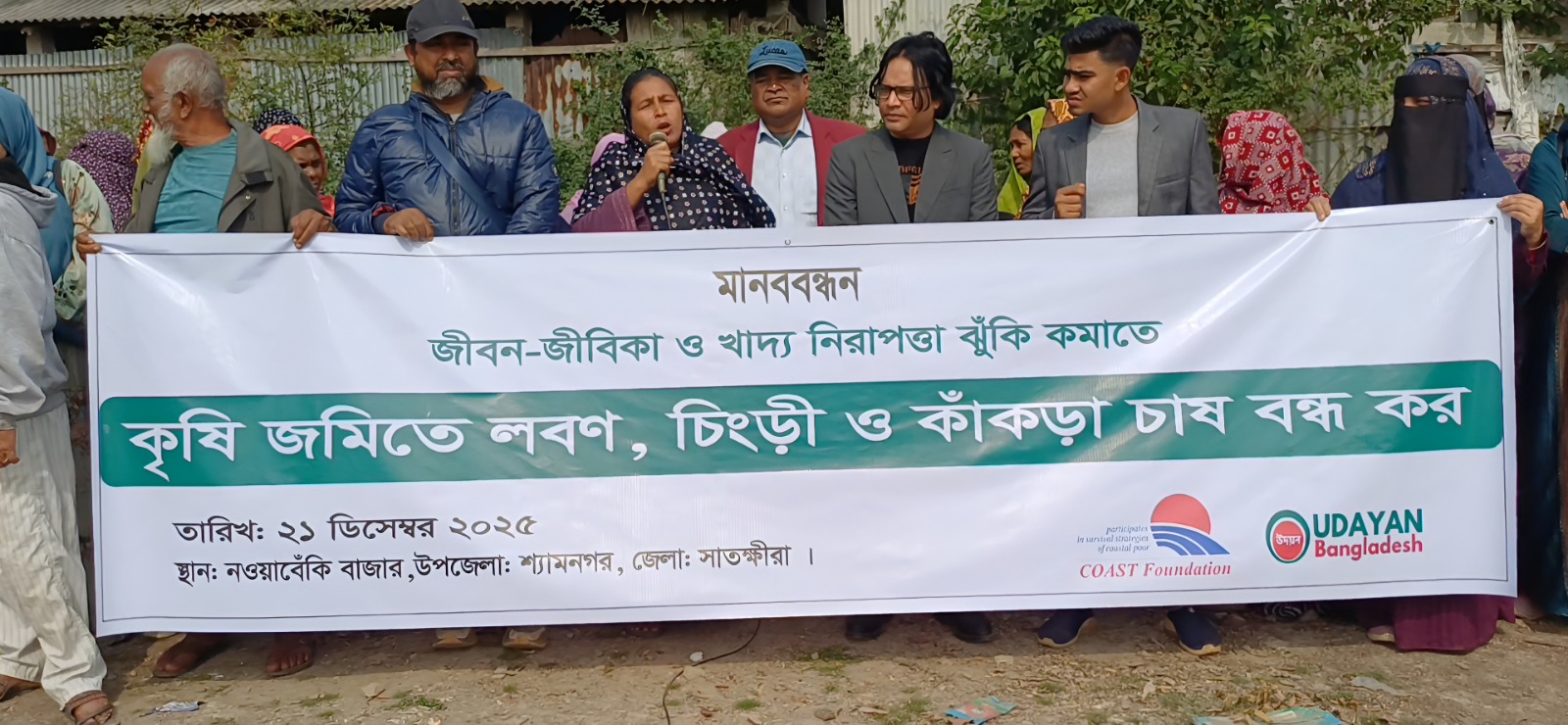
Shrimp and crab farming by introducing saline water into agricultural land is destroying cropland, reducing soil fertility, and severely impacting the livelihoods of local people. Due to this, food production is decreasing, and the agriculture-dependent population is facing long-term risks.
Therefore, it is essential to halt salt, shrimp, and crab farming on agricultural land to ensure livelihoods and food security. The entry of saline water into agricultural land must be completely stopped, effective laws must be implemented to prohibit shrimp and crab farming in cropland, alternative income and rehabilitation measures must be ensured for the affected farmers, and land use changes must be stopped without the consent of the local people. We must return to agriculture.
Speakers raised these demands at a human chain held at Nawabenki Bazar in Shyamnagar Upazila of Satkhira district on December 21, 2025.
COAST Foundation and Udayan Bangladesh jointly organized this human chain. Head of Climate Change of COAST Foundation, Mr. M.A. Hasan, moderated this event.
The event was presided over by Sheikh Asad, Executive Director of Udayan Bangladesh. Many others spoke at this human chain.
M. A. Hasan of COAST Foundation said, apart from natural disasters caused by climate change, shrimp or crab enclosures are artificially making the area saline and increasing environmental disasters. Although salt, shrimp and crab farming by injecting saline water into agricultural land are profitable for some people, it is also destroying biodiversity and pushing the future of many people towards uncertainty by destroying their land, food, and livelihood. As salinity in croplands increases permanently, the lands remain uncultivable for many years.
The Agricultural Land Preservation Act (ALPA) 2000 states that if any agricultural land is to be converted for industrial, residential, or any other non-agricultural use, the approval of the Ministry of Land is mandatory, we want to see strict implementation of the law.
Sheikh Asad, Executive Director of Udayan Bangladesh, said that due to shrimp and crab farming in Shyamnagar and Satkhira, agricultural production and land formation are under threat due to the salinity intrusion, directly affecting local agriculture and livelihoods. Agricultural lands are becoming unusable in the long term. In this situation, many farmers are forced to abandon their homes and agricultural work, migrating or moving elsewhere in search of a livelihood.
Monthly allowances, short-term loans, or assistance to start new businesses are important for the affected farmers.
Shyamnagar Press Club President Samiul Islam Monir said, the illegally granted canal lease must be cancelled; river erosion is intensifying due to illegal sand extraction; illegal sand extraction must be stopped. We must return to agriculture; our lands have become single-crop lands, we must convert them into triple-crop lands, and we must increase our rice and vegetable production to achieve self-sufficiency in food.
Shibu Prasad Vaidya, executive director of the Ganachetna Foundation, said, there is already a severe shortage of drinking water throughout the coastal region. Wherever shrimp and crab farming are prevalent, the shortage of drinking water is more severe. If the uncontrolled shrimp and crab farming is not brought under strict regulations now, the environment, nature, and economy of the southwestern region will be further disrupted. The encroachment of salt, shrimp, and crab farming on agricultural land must be stopped.
Jharna Khatun, a female representative of the affected population, said, we women are at grave risk due to the effects of salt poisoning; our health risks are increasing day by day. Due to the decline in agricultural production, food crises are occurring locally. Agriculturally dependent families are unable to produce their own food, increasing their dependence on the market.
Due to poverty and rising commodity prices, families, especially women and children, are suffering from malnutrition due to lack of supply according to demand. The crisis of clean water in the coastal region is intensifying. The government must take effective steps for a sustainable solution, she said.
Development activist Imran Parvez said that there is an acute shortage of drinking water, the government must take effective initiatives to address it, develop climate-adapted agricultural management, train farmers on this issue, and increase incentives for them.
Unauthorized use or reproduction of The Finance Today content for commercial purposes is strictly prohibited.