⊕ Oversight Gaps ⊕ Tax Evasion, Customs Fraud & Special Privileges Major hurdles to meeting target
Massive Revenue Target: Curbing Tax Evasion and Customs Fraud the Biggest Challenge
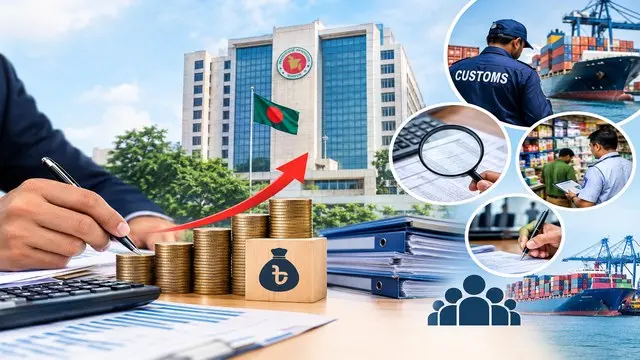
NBR Faces Mounting Pressure to Meet Target; Calls Grow for Greater Scrutiny of Tax Evasion, Customs Fraud and Special Privileges for Influential Taxpayers
The government has set an ambitious revenue collection target for the 2026–27 fiscal year, placing the National Board of Revenue (NBR) under mounting pressure to deliver. The NBR is expected to collect Tk 604,000 crore during the fiscal year, despite falling significantly short of its revised target in the previous year. Achieving the new goal will require a substantial increase in revenue collection, alongside stronger efforts to curb tax evasion, prevent VAT irregularities, combat customs fraud and recover outstanding tax liabilities.
The challenge extends beyond revenue collection to questions of transparency and accountability within the tax administration. Tax assessment, VAT audits, customs valuation, tax exemptions, VAT refunds and the settlement of tax disputes are among the areas where effective oversight is essential to minimise the risk of irregularities. Calls are also growing for impartial investigations into allegations involving influential taxpayers and equal enforcement of the law, irrespective of an individual’s or company’s influence.
However, the existence of risks does not, in itself, establish that corruption has occurred. Specific allegations must be assessed through documentary verification, independent audits and impartial investigations.
Nearly 45% Growth Required to Meet Target
According to the government’s budget plan, the overall revenue collection target for FY2026–27 stands at Tk 695,000 crore, of which Tk 604,000 crore is expected to be collected through the NBR.
According to the NBR’s provisional figures, the board collected Tk 415,473 crore in FY2025–26, against a revised target of Tk 503,000 crore. The shortfall stood at Tk 87,527 crore.
To achieve the new target, the NBR will need to increase collections by approximately 45% over the previous fiscal year’s actual receipts. This represents a significant jump in the amount of revenue the tax authority must mobilise within a single year.
The key question is whether such growth is achievable given the existing capacity of the tax administration, the state of business and trade, and broader economic conditions. Merely putting additional pressure on field-level officials, issuing frequent notices or conducting enforcement drives is unlikely to be sufficient.
A more effective strategy would require realistic revenue planning, expansion of the tax base, recovery of outstanding liabilities and targeted action against major sources of tax evasion.
Narrow Tax Base and Concealed Income Remain Major Obstacles
One of the longstanding challenges facing Bangladesh’s revenue system is the difficulty of establishing accurate records of income and business transactions. Cash-based transactions, informal economic activities and incomplete disclosure of income and expenditure can make it difficult to determine the actual taxable income of individuals and businesses.
Expanding the number of registered taxpayers is important, but registration alone cannot guarantee higher revenue. Authorities must ensure regular filing of tax returns, verify declared income and assets, and collect the taxes legally due.
Data-driven scrutiny of professionals, high-income individuals, major businesses and wealthy taxpayers could help identify discrepancies between declared income and actual financial activity. Such scrutiny, however, must be conducted transparently and without unnecessary harassment of legitimate taxpayers.
VAT Evasion Threatens Revenue Collection
Value-added tax (VAT) is one of the government’s principal sources of revenue. However, the concealment of sales, underreporting of transactions, use of fake invoices, improper input VAT claims and business operations without the required registration can all contribute to revenue leakage.
Wholesale and retail businesses, restaurants, service providers and enterprises with high sales volumes require particular attention. Declared sales should be compared with actual transactions wherever reliable records are available.
Greater use of electronic invoices and integrated analysis of banking transactions, inventory records and sales data could help identify discrepancies. Stronger VAT return verification, risk-based audits and transparent reporting of actual recoveries are also essential to improve compliance.
Customs Fraud and Bonded Warehouse Misuse Under Scrutiny
Customs is a critical component of revenue collection. Accurate valuation of imported goods, proper product classification and collection of applicable duties and taxes are essential to protecting government revenue.
Potential irregularities include under-invoicing imports, misclassification under Harmonized System (HS) codes, misdeclaration of goods and misuse of duty exemptions.
Bonded warehouse facilities also require effective oversight. Under these arrangements, eligible businesses can import certain materials duty-free for use in export-oriented production. If such materials are diverted to the domestic market in violation of applicable rules, the government may lose revenue.
Authorities need to verify whether imported raw materials are being used for their approved purposes. Import and export documents, production capacity, inventory records, export volumes and domestic sales data should be examined together to identify discrepancies.
Inspections at the time of customs clearance alone may not be sufficient to detect all irregularities. Stronger post-clearance audits, intelligence-led inspections and risk-based screening of consignments are therefore essential.
Tax Exemptions and Special Privileges Require Transparency
Tax exemptions and preferential facilities can encourage investment, production and employment. However, if their necessity, duration and economic benefits are not regularly assessed, they may unnecessarily reduce the government’s potential revenue.
Authorities should evaluate how much revenue is forgone through exemptions and whether the facilities generate measurable gains in investment, employment or production. Incentives that are no longer justified should be reviewed in accordance with the relevant laws and policies.
Transparency is particularly important when special facilities are granted to influential individuals or businesses. Any allegation of preferential treatment should be examined against the applicable legal framework, policy provisions and documentary evidence.
Not every exemption or special facility constitutes an irregularity. The legal basis, policy objectives and justification for each decision must be considered before drawing conclusions.
Collection Pressure Raises Questions About Accountability
Pressure to increase revenue collection can adversely affect legitimate businesses and investment if it results in excessive demands or unnecessary harassment. At the same time, the potential misuse of discretionary powers in tax assessment, audits, customs valuation and dispute settlement cannot be overlooked.
When additional tax demands are raised against a business over alleged evasion, the grounds for the assessment, the status of any investigation or appeal, and the amount ultimately collected should be properly documented and disclosed where legally permissible.
Issuing a large tax demand is not the same as collecting the money. The effectiveness of enforcement should therefore be measured not only by the number of cases filed or irregularities identified, but also by the actual revenue deposited into the public exchequer.
Delays in resolving tax disputes, failure to recover outstanding liabilities and allegations of unequal treatment also warrant scrutiny. Specific allegations of bribery, improper settlements or abuse of authority within the revenue administration should be investigated independently, with legal action taken where wrongdoing is established.
Digital Monitoring and Accountability Are Essential
Greater use of technology could help the NBR improve compliance and identify revenue leakage. Integrating income tax, VAT and customs data would allow authorities to examine inconsistencies among declared income, business transactions, imports, exports and reported assets.
The NBR should regularly disclose collection progress, outstanding tax liabilities, pending cases, audit findings and actual recoveries across its divisions. Effective complaint mechanisms, impartial appeal procedures and greater accountability in administrative decisions are equally important.
Performance assessments of revenue officials should not depend solely on the amount of additional tax demanded. Actual collections, recovery of outstanding liabilities, identification of evasion, quality of taxpayer services and effective resolution of complaints should also be taken into account.
Ambitious Target Requires Effective Reform
Meeting the government’s revenue target is essential for budget implementation and public expenditure. But a sustainable revenue system cannot be built solely on penalties, notices and enforcement drives.
The NBR needs to broaden the tax base, identify major sources of evasion, prevent misuse of bonded warehouse facilities, recover outstanding taxes, review the rationale for exemptions and strengthen technology-based monitoring. At the same time, tax compliance should be made simpler and more transparent to reduce unnecessary burdens on legitimate taxpayers.
The NBR faces a dual challenge: achieving the ambitious target of Tk 604,000 crore in revenue collection while ensuring transparency, fairness and accountability throughout the revenue administration.
The ultimate measure of success will not be the amount collected alone. It will also depend on how much tax evasion is prevented, how much outstanding revenue is recovered, how effectively irregularities are addressed and whether public confidence in the tax system improves.
Shamiur Rahman