
- Economy /
- Amir Khasru identifies crisis in Bangladesh’s private sector in Washington

Staff Correspondent
Published:2026-04-18 16:52:45 BdST
Amir Khasru identifies crisis in Bangladesh’s private sector in Washington
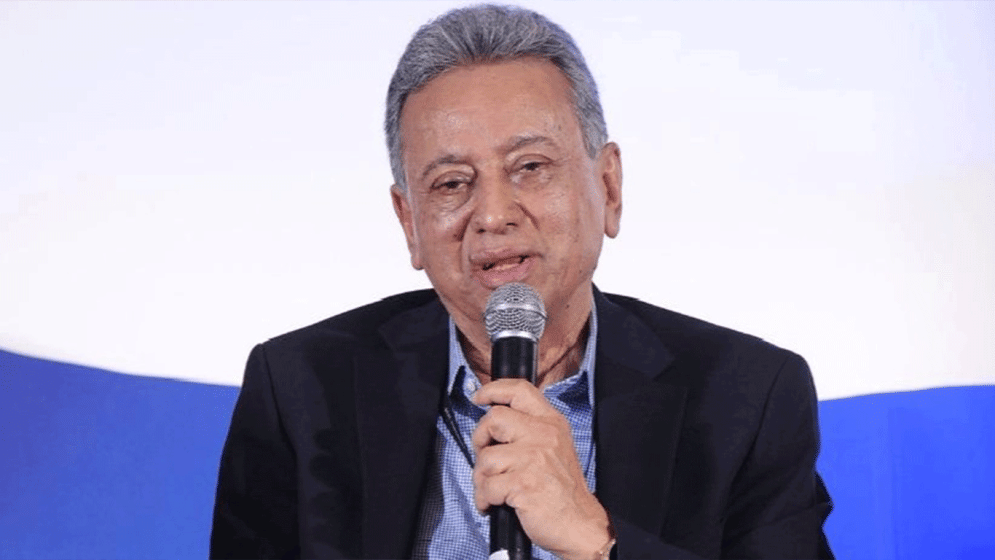
Finance Minister Amir Khasru Mahmud Chowdhury has said that Bangladesh’s private sector is facing a severe crisis, warning that the country’s growth engine is now under serious pressure.
He made the remarks on Thursday night in Washington DC at an event organised by policy research institution Atlantic Center. The discussion on Bangladesh’s economic future was moderated by Senior Fellow Michael Kugelman.
The minister said the economy inherited by the current government requires deep reassessment, describing the financial sector as being in a crisis state and the capital market as severely stagnant.
He also claimed that more than $200 billion had been siphoned out of Bangladesh, creating an acute shortage of capital in the domestic market.
Private sector under pressure
Amir Khasru said Bangladesh’s economic growth had historically been driven by the private sector, but that same sector is now in extreme distress.
He said previous economic strategies had centered on private enterprise, but rescuing the sector has now become the government’s biggest challenge.
According to the minister, the banking sector is in a fragile condition, with many banks effectively insolvent. He stressed the urgent need for recapitalisation of troubled banks.
Capital erosion and weak production
The finance minister said several factors were behind the capital crisis in the private sector.
He argued that the economy had long been oligarchic and group-based, preventing ordinary businesses from operating in a true market environment.
He added that the depreciation of the Bangladeshi currency by nearly 40%, along with an additional 10% erosion from inflation, had wiped out nearly half of business capital and working capital.
As a result, many businesses are operating weakly, with production falling sharply. In some cases, output has reportedly dropped to 30 to 40% of previous levels.
He said this low productivity has pushed many firms into losses, further depleting their remaining capital.
Priority is capital support
The minister said Bangladesh is telling the International Monetary Fund and World Bank that the first priority should be addressing capital shortages in the private and banking sectors.
He warned that no reform programme would succeed unless capital is restored to those sectors.
He also noted that Bangladesh’s tax-to-GDP ratio, once around 11%, has fallen below 7%.
While increasing the ratio is necessary, he said higher tax collection would not be possible unless businesses recover first.
Need for two-year financial support
Khasru said Bangladesh’s most urgent need is a financial support arrangement for the next two years to recapitalise banks and revive the private sector.
He said strengthening these two sectors should be the country’s highest priority.
Energy imports and US talks
Responding to a question from Michael Kugelman about energy imports from Russia, the minister said Bangladesh had sought a waiver from the United States and had finally received approval.
He said Russian oil is comparatively cheaper than buying from the spot market, which would help lower costs for Bangladesh.
He added that energy cooperation between Bangladesh and the United States has not progressed significantly so far, but talks are continuing with US energy, treasury, and foreign affairs officials.
Meeting with US official
Meanwhile, the finance minister also met Assistant Secretary Paul Kapur of the US State Department’s Bureau of South and Central Asian Affairs on Thursday.
According to a post by Kapur on X, the meeting discussed deepening trade and investment ties between the United States and Bangladesh, including improved market access, energy cooperation, and opportunities for US investment in critical infrastructure sectors.
Unauthorized use or reproduction of The Finance Today content for commercial purposes is strictly prohibited.