
- National /
- Advisory Council approves 4 ordinances

Staff Correspondent
Published:2026-01-09 00:32:51 BdST
Advisory Council approves 4 ordinances
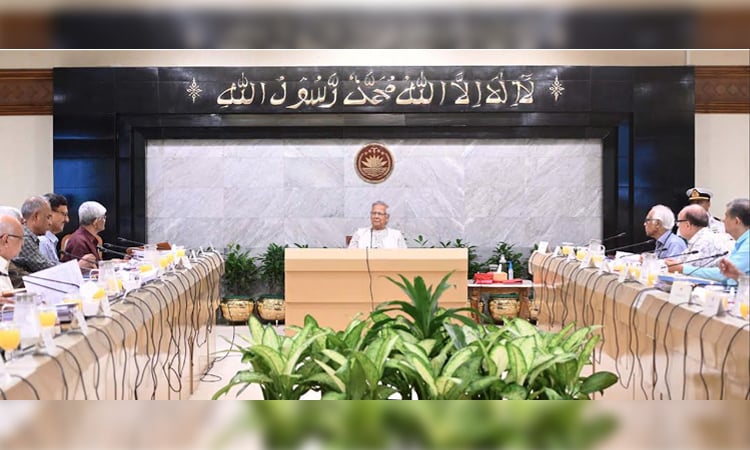
The Advisory Council approved ordinances on data protection and three other issues on Thursday.
The ordinances include the draft and policy approval of the Personal Data Protection (Amendment) Ordinance 2026, the Bangladesh Shilpakala Academy (Amendment) Ordinance 2026, the Supreme Court Secretariat (Amendment) Ordinance 2026 and the draft of the Bangladesh Forest Industries Development Corporation Ordinance 2026.
In addition, the Advisory Council granted ex-post facto approval to the “Third Nationally Determined Contribution (NDC-3)” prepared by the Ministry of Environment, Forest and Climate Change.
The information was shared by Chief Adviser’s Press Secretary Shafiqul Alam at a briefing held at the Foreign Service Academy following the meeting.
The Advisory Council meeting was held on Thursday at the Chief Adviser’s Office in Tejgaon, Dhaka, with Chief Adviser Professor Muhammad Yunus presiding.
Personal Data Protection (Amendment) Ordinance 2026
Shafiqul Alam said that amendments to the Personal Data Protection Ordinance were made after considering concerns raised by international technology companies, particularly regarding data localisation.
Under the revised provisions, mandatory data storage within Bangladesh will apply only to critical information infrastructure. Certain relaxations have been introduced for personal data, and provisions for financial penalties have been included instead of imprisonment for companies.
He expressed hope that these changes would have a positive impact on foreign investment and cloud-based services.
Supreme Court Secretariat (Amendment) Ordinance 2026
The interim government has amended an ordinance to include a retired chief justice as a member of the Supreme Court Secretariat Commission.
The Supreme Court Secretariat Ordinance, 2025 was issued on Nov 30 to establish a separate secretariat ensuring the full independence of the judiciary. The ordinance lists the members of the commission.
The ordinance listed the members of the commission as:
• A chief justice, who will also serve as chairman;
• Minister or advisor of the Ministry of Law, Justice and Parliamentary Affairs;
• A judge of the Appellate Division nominated by the chief justice;
• Chair of the National Human Rights Commission;
• Attorney general.
According to the ordinance, the then chief justice Syed Refaat Ahmed served as the chairman. After his retirement, the position was held by the current Chief Justice Zubayer Rahman Chowdhury. The amendment now allows Refaat to also serve as a member.
Bangladesh Shilpakala Academy (Amendment) Ordinance 2026
Regarding the Bangladesh Shilpakala Academy (Amendment) Ordinance, the press secretary said the number of departments has been increased to nine. Separate departments have been created for theatre, film, photography, dance and performance art, music, fine arts, research and publication, new media, and cultural branding and festival production.
Provisions have also been added to ensure representation of marginalised communities on the academy’s board, which is expected to enhance cultural diversity and inclusion.
Bangladesh Forest Industries Development Corporation Ordinance 2026
On the Bangladesh Forest Industries Development Corporation Ordinance 2026, Shafiqul Alam said the 1959 Forest Industry Development Corporation Ordinance has been modernised through a new structural framework.
The updated ordinance focuses on sustainable use of forest resources while ensuring environmental conservation, along with opportunities for product diversification, showroom establishment, and joint ventures.
He added that in the last fiscal year, the corporation earned Tk5.3 billion in pre-tax profit and recorded a profit of Tk600 million in the rubber industry for the first time.
Speaking about NDC-3, Shafiqul Alam said Bangladesh’s greenhouse gas emissions stood at 202.04 million tonnes of carbon dioxide equivalent in 2022 and could rise to 418.40 million tonnes by 2035.
Under NDC-3, a target has been set to reduce emissions by 84.97 million tonnes, including a reduction of 26.74 million tonnes through domestic capacity and a further 58.23 million tonnes subject to the availability of international support.
Chief Adviser’s Special Assistant Prof Sayedur Rahman and Deputy Press Secretary Abul Kalam Azad Majumdar were also present at the briefing.
Unauthorized use or reproduction of The Finance Today content for commercial purposes is strictly prohibited.