Highlighting Revolution’s Legacy
Algeria seeks stronger ties with BD: Envoy
Its lessons remain relevant to contemporary debates over sovereignty, international justice, self-determination and the lasting effects of colonialism
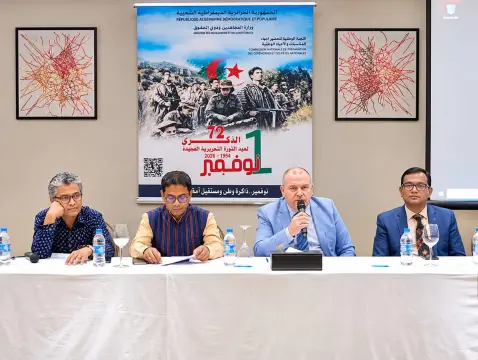
The conference, titled “The Algerian Revolution of November 1, 1954, and Its Impact on International Relations,” was held at Le Méridien Dhaka on Saturday to mark the 72nd anniversary of the uprising against French colonial rule.
Ambassador Abdelwahab Saïdani said the revolution was more than a struggle for national independence, describing it as a turning point in the global campaign against colonialism and a defining moment in the pursuit of human rights, dignity and national sovereignty.
Algeria fought a protracted war against 132 years of French colonial rule before securing independence in July 1962. The struggle subsequently inspired liberation movements across Africa, Asia and Latin America, establishing Algeria as a prominent advocate of anti-colonial solidarity.
“The Algerian Revolution was not merely a national struggle for independence,” Saïdani said, highlighting its enduring influence on international diplomacy and the right of peoples to determine their political future.
He noted that the conflict contributed to the political crisis that brought down France’s Fourth Republic in 1958 and preceded the establishment of the Fifth Republic. The struggle also helped galvanise international support for decolonisation, culminating in broader recognition of the right to independence through United Nations General Assembly Resolution 1514 in 1960.
The revolution, he said, exposed a fundamental contradiction in the international system: the promotion of universal human rights alongside the denial of freedom and political rights to people living under colonial rule.
After independence, Algeria emerged as a centre of support for liberation movements worldwide, earning the nickname “Mecca of Revolutionaries”. The writings of intellectuals Frantz Fanon and Jean-Paul Sartre also helped bring the violence, psychological trauma and injustices of colonialism to international attention.
Shared history, closer ties
Saïdani drew parallels between Algeria’s liberation struggle and Bangladesh’s own history of independence, saying the shared values of sacrifice, dignity, sovereignty and self-determination provided a foundation for stronger bilateral relations.
He called for deeper friendship between Dhaka and Algiers, greater solidarity among countries of the Global South, peaceful resolution of international disputes and renewed commitment to humanitarian principles.
“Long live Algeria. Long live Bangladesh. Long live the friendship between our two peoples,” the ambassador said in closing.
The conference also explored the revolution’s impact on world politics through a keynote paper by Professor S. M. Shamim Reza of the Department of Mass Communication and Journalism.
In his paper, “The Algerian Revolution of 1954: Its Impact on International Relations and World Politics,” Reza argued that the uprising helped accelerate the transition from European colonial dominance towards an international order increasingly defined by independent and sovereign states.
He said the National Liberation Front (FLN), which launched the uprising on November 1, 1954, internationalised Algeria’s independence campaign through diplomacy, media engagement and alliances with sympathetic governments and liberation movements.
These efforts helped move the conflict beyond France’s attempt to frame it as an internal security matter, bringing Algeria’s struggle to the United Nations and other international forums.
Reza also examined the revolution’s implications for France’s relations with the United States, NATO and the United Nations, as well as its contribution to Afro-Asian solidarity following the 1955 Bandung Conference.
The Evian Accords, signed in March 1962, marked a decisive step towards ending the war and paved the way for Algeria’s independence later that year.
The Algerian experience, he said, demonstrated how armed resistance, diplomatic engagement, international solidarity and political pressure could combine to transform a national liberation movement into a force with far-reaching geopolitical consequences.
Its lessons remain relevant to contemporary debates over sovereignty, international justice, self-determination and the lasting effects of colonialism, he added.
A diplomatic message beyond commemoration
For Algeria’s embassy in Dhaka, the anniversary offered an opportunity to connect the country’s liberation history with present-day diplomatic priorities, including cooperation among developing nations, respect for sovereignty and peaceful international relations.
The conference underscored the continuing significance of historical solidarity in relations between countries that experienced struggles for independence. Speakers expressed hope that the shared values of Bangladesh and Algeria would help deepen mutual understanding and expand bilateral cooperation.
As questions of national sovereignty, international justice and the rights of peoples remain central to global affairs, the anniversary served as a reminder that the legacy of decolonisation continues to shape diplomacy far beyond the battlefields where independence movements began.
Shamiur Rahman