Pakistan’s First Astronaut Makes History, Holds Live Conversation with PM from Space
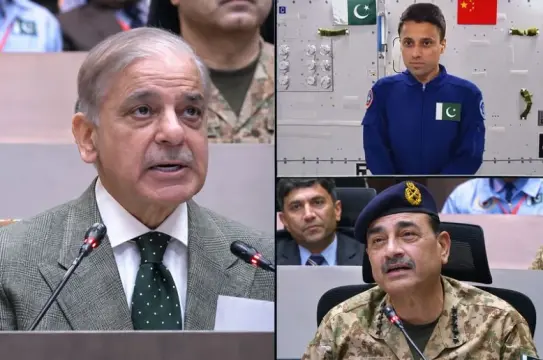
Shehbaz Sharif hails landmark mission aboard China’s Tiangong Space Station; four Pakistani university experiments underway, marking a new chapter in Pakistan-China scientific cooperation
Pakistan has entered a new era of space exploration, with its first astronaut, Wing Commander Muhammad Zeeshan Ali, making history by travelling into Earth's orbit and joining China's crewed space programme aboard the Tiangong Space Station.
In a landmark moment, Prime Minister Muhammad Shehbaz Sharif, accompanied by Chief of Defence Forces and Chief of Army Staff Field Marshal Syed Asim Munir, held a live conversation with the astronaut from the headquarters of Pakistan's Space and Upper Atmosphere Research Commission (SUPARCO) in Islamabad on Saturday.
Deputy Prime Minister and Foreign Minister Senator Mohammad Ishaq Dar and Chinese Ambassador to Pakistan Jiang Zaidong were also present during the historic interaction.
Wing Commander Zeeshan Ali reached space on 25 November 2026 aboard China's Shenzhou-24 spacecraft, launched atop a Long March-2F rocket from the Jiuquan Satellite Launch Centre.
His journey marks two significant milestones: he is the first Pakistani to enter Earth's orbit and the first foreign astronaut to participate in China's crewed space programme aboard the Tiangong Space Station.
During the mission, the Pakistani astronaut is participating in scientific research, including four experiments developed by Pakistani universities. The experiments focus on advanced materials, agricultural applications and biological research, potentially opening new avenues for scientific innovation and technological advancement.
Interacting with the astronaut, Prime Minister Shehbaz Sharif expressed immense pride in the achievement, describing it as a historic milestone for Pakistan. He said the knowledge, expertise and experience gained through the mission would create new opportunities for the country's scientific and technological development, particularly in space exploration.
The prime minister also acknowledged China's support and cooperation, praising SUPARCO, Pakistani scientists, academic institutions and the armed forces for their contributions to making the mission possible. He expressed confidence that the achievement would inspire younger generations to pursue excellence in science, technology and innovation.
Field Marshal Syed Asim Munir congratulated the astronaut, describing his presence aboard the Chinese space station as a proud reflection of the enduring strategic partnership between Pakistan and China.
Referring to the longstanding friendship between the two countries, Shehbaz Sharif observed that a relationship traditionally described as higher than the Himalayas and deeper than the oceans had now soared beyond the skies. The milestone comes as Pakistan and China celebrate 75 years of diplomatic relations.
The mission represents a significant expansion of bilateral cooperation, taking the partnership beyond conventional economic, diplomatic and defence ties into human spaceflight, advanced scientific research and emerging technologies.
With Pakistani university experiments being conducted aboard China's orbital laboratory, the mission is also expected to strengthen academic collaboration, promote knowledge-sharing and create opportunities for future joint space exploration.
For Pakistan, the historic journey is more than an achievement in space travel. It represents a significant step towards developing indigenous scientific capabilities and establishing a stronger presence in the rapidly evolving global space sector.
Shamiur Rahman