Rising bad loans, capital erosion and governance failures put financial stability under pressure
Bangladesh’s banking sector faces a reckoning
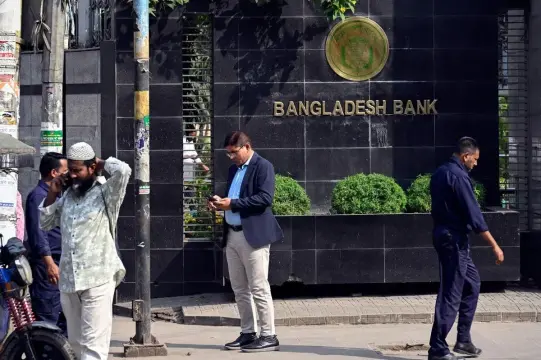
Speakers said at a seminar, titled “Assessing the Financial Health of the Banking Sector,” at the CMJF office at Al-Razi Comple in Dhaka on Saturda
Bangladesh’s banking sector is facing mounting pressure from a toxic combination of soaring non-performing loans (NPLs), capital shortages, liquidity stress and weak governance, speakers said at a seminar in Dhaka on Saturday.
They stressed that restoring the health of the banking system would require more than liquidity support or bank mergers, calling for stronger governance, tighter supervision, legal reforms and greater transparency in recognising bad assets.
The seminar, titled “Assessing the Financial Health of the Banking Sector,” was jointly organised by the Capital Market Journalists’ Forum (CMJF) and the CFA Society Bangladesh at the CMJF office at Al-Razi Complex.
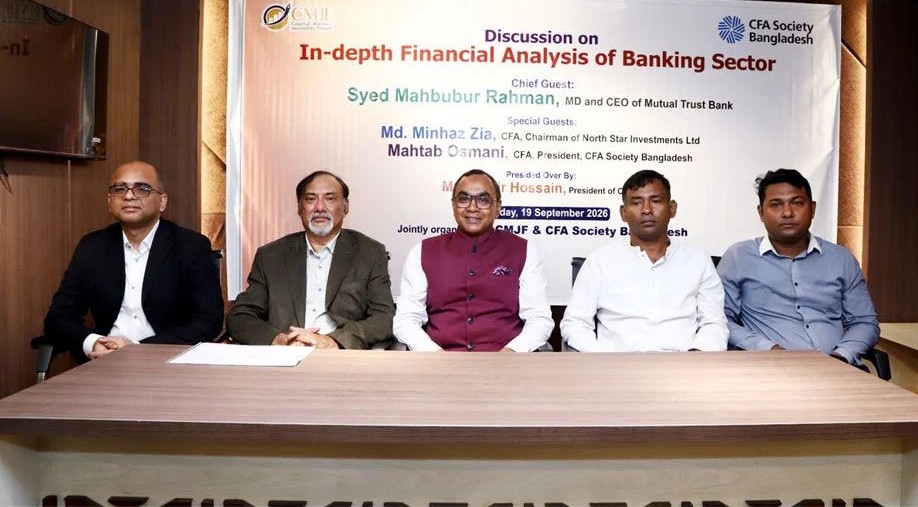
Former Association of Bankers, Bangladesh (ABB) chairman and Mutual Trust Bank Managing Director Syed Mahbubur Rahman was the chief guest.
CMJF President Md Monir Hossain chaired the event, while Sakib Chowdhury, research head of UCB Stock Brokerage, and Iqbal Hossain, chief financial officer of Sonali Bank, presented the keynote paper.
CFA Society Bangladesh President Mahtab Ur Rahman (Osmani) delivered the welcome address. Minhaz Zia, chairman of North Star Investments, spoke as a special guest. CMJF General Secretary Ahsan Habib Russell moderated the session.
Bad loans now the biggest headache
The scale of the banking sector's bad-loan problem has become a major concern.
Syed Mahbubur Rahman said classified loans, which stood at around Tk 22,000 crore in 2008, have now exceeded Tk 6 lakh crore.
He said the officially reported NPL ratio does not necessarily capture the full extent of stressed loans, particularly when loans enjoying various policy facilities are taken into consideration.
The latest international assessments point to the severity of the problem.
The World Bank said Bangladesh's banking-sector NPL ratio reached 32.6 per cent in March 2026, compared with an average of 7.9 per cent for South Asian banks. It also said the system-wide capital-to-risk-weighted-assets ratio had fallen to negative 2.6 per cent at the end of 2025.
The figures highlight the extent to which years of weak lending discipline and inadequate risk management have eroded banks' balance sheets.
Profit from government securities is no substitute for lending
Syed Mahbubur Rahman also sought to dispel what he described as a misconception about banks' earnings.
In recent years, banks have benefited from income generated through foreign-exchange transactions and investments in government securities. But that does not mean their core banking business is healthy, he said.
“The core business of a bank is lending,” he noted, adding that banks' net interest income has come under significant pressure.
The distinction is important because investment income is generally viewed on a gross basis, while income from lending is assessed after deducting the cost of deposits.
A bank may therefore report substantial investment income while simultaneously experiencing weakness in its core lending business.
Capital position under pressure
The deterioration in asset quality has also put banks' capital positions under severe strain.
The IMF reported that Bangladesh's banking-sector NPL ratio had risen to 24 per cent in March 2025, while the system-wide capital adequacy ratio had fallen to 6.4 per cent. The Fund also cautioned that reported capital was overstated because of significant deferred loan-loss provisions at 27 banks.
The World Bank subsequently reported an even weaker picture, with system-wide capital-to-risk-weighted assets turning negative at the end of 2025.
This means that simply injecting liquidity into troubled banks may not resolve the underlying problem if losses remain unrecognised and capital is inadequate.
IFRS 9 could expose more losses
Syed Mahbubur Rahman warned that banks could face substantially higher provisioning requirements once IFRS 9, the international accounting standard for financial instruments, is fully implemented.
Bangladesh is preparing to introduce IFRS 9 in the banking sector, a move that will require banks to recognise expected credit losses rather than waiting for loans to become clearly impaired.
That could put additional pressure on banks with weak loan portfolios, forcing them to recognise losses earlier and potentially requiring fresh capital.
Liquidity problems are uneven
The banking sector's liquidity situation is more complicated than a simple system-wide cash shortage.
Bangladesh Bank's Financial Stability Report 2025 showed that the sector's overall liquidity position remained broadly stable, while some segments—particularly Islamic banks—faced greater pressure.
The report said the advance-to-deposit ratio fell to 77.72 per cent, while high-quality liquid assets increased by 20.18 per cent to Tk1,017.38 billion.
The figures suggest that liquidity exists within the financial system, but its distribution and the financial health of individual banks remain critical issues.
‘Merging weak banks won't solve the problem’
The speakers also questioned whether bank mergers alone could repair the sector.
Syed Mahbubur Rahman said a merger could make sense when a stronger bank can integrate another institution's technology, systems and operations.
But simply combining several weak banks would not necessarily create a stronger institution.
“If weak banks are merged with other weak banks, the underlying problems will remain,” was the substance of his argument.
A merger cannot by itself erase bad loans, restore depleted capital or fix governance failures.
Governance is the bigger issue
For Bangladesh's banking sector, the problem increasingly appears to be institutional rather than merely financial.
The World Bank has identified weak corporate governance, regulatory capture and related-party lending among the key factors behind the deterioration of the banking sector.
The IMF has also called for stronger bank governance, better risk management, improved supervision, transparent recognition of losses and a credible framework for resolving non-viable banks.
The message from the seminar was therefore clear: capital injections without governance reform could provide only temporary relief.
Banks dominate Bangladesh's financial system
Minhaz Zia said the country's dependence on banks makes the sector's problems particularly consequential.
He said around 80–90 per cent of total savings are held in the banking system, while the capital market accounts for a relatively small share.
The World Bank estimates that banks account for around 90 per cent of Bangladesh's total financial-sector assets.
That concentration means a prolonged banking-sector crisis could affect not only depositors and lenders but also investment, employment, private-sector credit and overall economic activity.
Technology can cut costs—but not overnight
Asked about banks' operating expenses, Syed Mahbubur Rahman said around 75 per cent of costs are difficult to control in the short term, including rent, salaries and insurance.
Artificial intelligence and other technologies could improve efficiency over time, he said, but banks cannot drastically cut operating costs overnight.
The challenge is therefore to modernise banking operations while maintaining adequate investment in technology, cybersecurity, risk management and human resources.
Financial literacy needed to rebuild confidence
Mahtab Ur Rahman (Osmani) stressed the need to explain banks' financial condition and capital adequacy to ordinary depositors and investors in simple language.
Greater financial literacy would help people distinguish between verified information and rumours, he said.
That is particularly important when concerns over weak banks can quickly trigger anxiety among depositors and investors.
Reform, not cosmetic fixes
The discussion at Saturday's seminar points to a broader conclusion: Bangladesh's banking-sector crisis cannot be fixed through higher lending rates, government securities income or mergers alone.
The immediate priorities are recognising bad loans honestly, rebuilding capital, strengthening bank governance, improving supervision and creating an effective legal framework for resolving troubled institutions.
For an economy where banks dominate financial intermediation, restoring the health of the banking sector is not simply a matter of protecting individual institutions. It is central to restoring confidence in credit, investment and economic growth.
Shamiur Rahman