
- National /
- HISTORIC POLLS TODAY

Shamiur Rahman Lipu
Published:2026-02-12 08:16:59 BdST
Across 299 Electoral Constituencies of BD HISTORIC POLLS TODAY
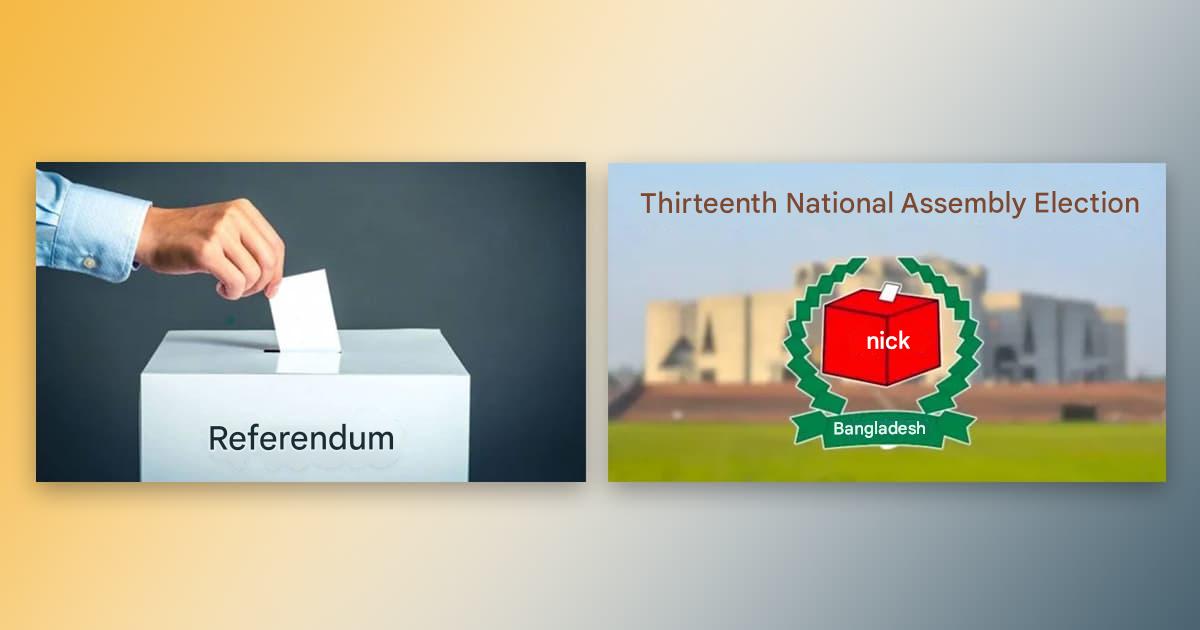
Bangladesh goes to the polls today in one of the most consequential elections in the country’s history, as millions of voters cast their ballots with renewed hope, anticipation and a profound sense that this vote could mark the beginning of democratic renewal after years of political erosion.
Polling for the 13th national parliamentary election, alongside a national referendum, is set to begin at 7:30am and will continue uninterrupted until 4:30pm across 299 constituencies, following the postponement of voting in one seat due to the death of a candidate.
At the centre of the electoral contest is a battle of symbols – the BNP’s “Paddy Sheaf” and the Jamaat-e-Islami’s “Scale” – representing rival political visions competing for control of the next parliament.
The main contest is expected to take place between the BNP-led seven-party alliance and the Jamaat-led 11-party coalition, which also include the youth-led National Citizen Party (NCP).
Other major parties in the race include Islami Andolan Bangladesh, the Jatiya Party, which served as a domestically aligned opposition force in parliament during the previous Awami League era, and a large number of independent candidates.
The parliamentary election in the Sherpur-3 (Shribordi-Jhenaigati) constituency has been postponed following the death of a candidate, reducing today’s voting to 299 constituencies instead of the full 300.
Candidate distribution shows 290 contenders from the BNP, 227 from Jamaat-e-Islami, 257 from Islami Andolan Bangladesh, 200 from the Jatiya Party, 32 from the NCP and 94 from Gono Odhikar Parishad.
A vote unlike the past
What sets this election apart from previous polls is the context in which it is being held.
After more than a decade marked by disputed elections, shrinking opposition space and declining public trust in electoral institutions, today’s vote follows months of political upheaval and a popular uprising in 2024 that demanded accountability, reform and the restoration of democratic norms.
For many voters, particularly young people, this election is the first in which they believe their vote may genuinely matter.
Trains, buses and river launches were packed in the days leading up to polling day as millions travelled from cities to their home constituencies, signalling an enthusiasm rarely seen in recent elections.
The Election Commission (EC) has repeatedly emphasised that this poll must be free, fair and credible, warning that any attempt to disrupt or manipulate the process will not be tolerated.
Youth vote in the spotlight
With nearly 49 million voters aged under 35 – accounting for roughly one-third of the country’s total electorate of 127.7 million – youth voters are expected to play a decisive role in determining outcomes in many constituencies.
Analysts believe their participation could reshape electoral dynamics, particularly in urban and semi-urban areas where political disengagement had previously been high.
In total, 50 political parties are contesting the election, fielding 2,028 candidates, including 273 independents and 83 women.
The breadth of participation is being cited as another indication of renewed political competition after years of constrained electoral contests.
All eyes are on the performance of BNP and Jamaat-e-Islami, the two major political forces seeking to secure a mandate to govern the country for the next five years.
First-time expatriate voting
Another historic feature of this election is the inclusion of expatriate Bangladeshis through an IT-based postal ballot system – a first in the country’s electoral history.
Despite limited preparation time, 766,862 expatriate voters registered for the process, according to the Election Commission.
Of these, 466,243 valid ballots were ultimately received by returning officers. In addition, 760,898 local voters registered through special arrangements, with 535,503 valid ballots received, the EC said.
While the numbers represent a small fraction of the overall electorate, officials and observers see the move as a significant step towards greater democratic inclusion.
Voters, centres & security
Bangladesh has a total of 127.71 million registered voters, including 64.82 million men, 62.88 million women and 1,232 voters identified as hijra. Voting is taking place at 42,779 polling centres nationwide, of which 21,273 are general centres and 21,506 have been classified as important or risky.
Nearly half of all polling centres have been designated as sensitive.
Observers & media scrutiny
To enhance transparency, the Election Commission has accredited 31,801 domestic and international election observers. Journalists from both local and international print and electronic media are also covering the polls under the electoral code of conduct.
Observers from 45 countries and organisations, including election management bodies and international institutions, are present to monitor the process – a level of international scrutiny rarely seen in previous elections.
Massive security deployment
To maintain law and order, the EC has deployed approximately 958,000 members of law enforcement agencies nationwide.
The deployment includes 100,003 army personnel, 5,000 navy members, 3,730 air force personnel, 37,453 Border Guard Bangladesh members, 3,585 Coast Guard personnel, 187,603 police officers, 9,349 Rapid Action Battalion members and 576,483 Ansar-VDP members.
In addition, 1,922 Bangladesh National Cadet Corps (BNCC) cadets and 45,820 village police members, including chowkidars and dafaders, have been deployed to support security operations.
Security personnel have been granted magisterial powers in some areas, and modern technology, including CCTV cameras, body-worn cameras and drones, is being used to monitor polling centres.
EC’s assurance
Chief Election Commissioner (CEC) AMM Nasir Uddin has reaffirmed the Election Commission’s commitment to delivering a credible and peaceful election.
“The election will be completed as promised to the people,” the CEC said while briefing international observers and media representatives at Hotel InterContinental in Dhaka on Wednesday.
He said the commission is working strictly in accordance with the Constitution and relevant laws to organise both the parliamentary election and the referendum scheduled for today.
“All necessary materials, including ballot papers, have already been distributed to returning officers and are being centrally dispatched to respective constituencies,” he said.
“Extensive security and coordination arrangements are in place with the support of law enforcement agencies and the government,” the CEC added, noting that any electoral disputes would be resolved in line with established legal and constitutional procedures.
“The participation of media and observers will play a significant role in ensuring maximum transparency and public trust in this election,” he said.
He also confirmed that today and election day have been declared public holidays to facilitate voter turnout.
Unauthorized use or reproduction of The Finance Today content for commercial purposes is strictly prohibited.