Fake Exports, Customs Evasion and Illegal Clearance Put Billions in Annual Revenue at Risk
White-Collar Crime Behind Bonded Warehouse Facilities
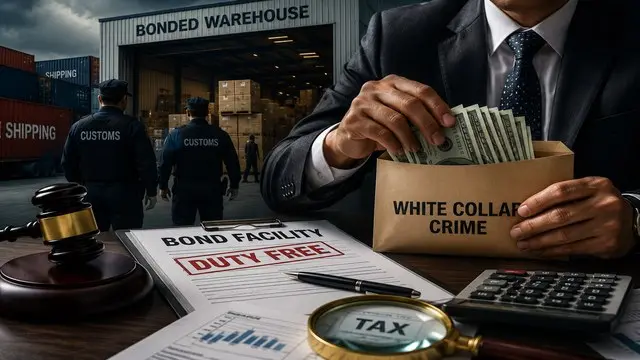
For years, Bangladesh’s investigative news outlet The Finance Today has been investigating the misuse of bonded warehouse facilities, customs evasion and related irregularities. An analysis of documents, statements from officials concerned and information surrounding several incidents has revealed a disturbing picture.
In legal and social terms, a “crime” generally refers to an act that violates existing law and is punishable by the state. In crimes such as murder, robbery, theft or violence, the damage is often visible. But there is another category of crime in which there may be no bloodshed or immediate loss of life, yet the consequences for the state, the economy and ordinary citizens can be extensive and long-lasting.
Financial fraud, tax evasion, embezzlement, forgery and money laundering committed by influential individuals, businesspeople, corporate entities or powerful groups are commonly described as white-collar crime.
Since the beginning of industrial development, securities fraud, corporate deception, embezzlement, customs evasion, market manipulation, “pump-and-dump” schemes and money laundering have emerged as major challenges to economic systems around the world. Bangladesh is no exception.
One important area of concern in Bangladesh is the alleged misuse of bonded warehouse facilities. The government introduced these facilities to help export-oriented industries remain competitive by allowing eligible businesses to import raw materials without paying customs duties and taxes. However, allegations suggest that a section of unscrupulous businesses is exploiting the system to sell bonded goods on the domestic market, show fake exports, import goods beyond approved limits and evade revenue.
There are also allegations of collusion between such businesses and some dishonest officials and employees of customs and revenue authorities.
The Finance Today has been investigating these allegations for an extended period. Documents, statements from officials and analysis of various incidents point to serious vulnerabilities in the system.
Bonded Facilities: Support for Industry or a Tool for Abuse?
The primary objective of the bonded warehouse system is to support export-oriented industries. Under the facility, approved businesses can import raw materials without paying applicable duties and taxes, subject to specific conditions.
The imported raw materials are supposed to be stored in designated warehouses and used to manufacture products that are subsequently exported.
Under the rules, such raw materials or finished products cannot be sold in the domestic market without customs approval and payment of applicable duties and taxes.
However, allegations suggest that some of the raw materials imported under bonded facilities are not used to manufacture export products but are instead diverted to the domestic market.
If goods imported duty-free under the bonded facility are sold locally, the applicable customs duties and taxes can range from approximately 89 percent to 159 percent, depending on the product. Therefore, if goods are sold domestically while exports are shown on paper, businesses may avoid substantial duties and taxes and, in some cases, create opportunities to claim export incentives.
Such abuse does more than deprive the government of revenue. It creates an uneven playing field for legitimate businesses and undermines confidence in the country’s overall trade system.
Weak Oversight—or Collusion?
According to data from the National Board of Revenue (NBR), around 9,500 establishments in Bangladesh enjoy bonded facilities. More than half are associated with the ready-made garment sector. Of nearly 6,000 establishments under the jurisdiction of the Dhaka Customs Bond Commissionerate, around 4,000 are garment-bonded enterprises.
Monitoring such a large number of businesses on a regular basis is a major challenge for customs authorities. A shortage of manpower is often cited as one of the key problems.
However, allegations emerging from various incidents suggest that the issue cannot be explained solely by manpower shortages.
Cases involving discrepancies in documents, mismatches in declared weights, imports based on false declarations, clearance of containers without proper inspection and the alleged payment of bribes for irregular facilities have raised questions about a section of customs and revenue officials.
At the same time, businesses have also been accused in some cases of using forged signatures and seals of customs officials to obtain clearance.
The following case studies illustrate the vulnerabilities and alleged abuse of the system.
Case Study 1: Fake Exports Worth Tk 240 Million Involving Seven Firms
Serious allegations of irregularities have emerged in Bangladesh’s export sector. During the first six months of this year, at least 29 consignments were recorded as exports even though the goods allegedly never reached the designated inland container depots or ports. The declared value of the consignments was approximately Tk 240 million.
According to documents, the consignments were supposed to be shipped to Italy, the United States, Austria, Sweden, the United Arab Emirates and Hong Kong. Although customs records showed the exports as completed, sources concerned said there was no evidence that the goods had actually travelled from the factories to the designated depots.
The 29 consignments examined so far were linked to at least seven companies: RT Fashion, HBS Apparels, Al Galib Fashion Ltd, Deluxe Apparels Ltd, NM Fashion, NM Knit Fashion and Bhuiyan Fabrics Ltd.
Shahjalal Enterprise, Alpha Textile Ltd and Bangladesh Shipping Agency were involved in the clearance and transportation processes. Summit Alliance Port Ltd and Port Link Logistics Centre Ltd were listed as the relevant depots.
According to customs officials, the 29 consignments identified so far may represent only part of the overall picture. Authorities are examining whether additional consignments were falsely shown as exports using the same method.
Concerns Over Money Laundering Behind Fake Exports
Officials involved in the investigation suspect that the alleged fake exports may be connected to the over-invoicing of imported goods and the transfer of excess funds abroad.
Their concern is that businesses may have inflated the value of imported goods to transfer additional money overseas and subsequently attempted to give those transactions a legitimate appearance through fictitious exports.
If proven, such activities could constitute offences under Bangladesh’s anti-money laundering laws.
An official involved in the investigation believes that the cases identified so far may represent only a small portion of a much larger network.
Case Study 2: RT Fashion’s Tk 8.4 Million “Export”
On May 24, RT Fashion, a garment manufacturer based in Narayanganj, declared the export of garments worth approximately Tk 8.4 million.
An agent responsible for the clearance and transportation of the goods submitted the export declaration on behalf of the company, after which it was recorded in the National Board of Revenue’s online customs management system. The declaration showed the total weight of the goods as 23,992 kilograms.
Under the normal procedure, the declared goods should first be transported to a designated inland container depot. Customs officials are then expected to inspect the goods, verify the documents and assess the shipment before sending it to Chattogram Port. The export is supposed to be completed once the goods are loaded onto a vessel.
In RT Fashion’s case, however, documents and statements from officials indicated that although the paperwork showed the export process as completed, there was allegedly no evidence that the goods reached the designated destination.
Officials also noticed another discrepancy. The export declaration showed the net weight and gross weight of the goods as identical. Normally, the gross weight should be higher because packaging and other materials add to the total weight.
After doubts arose, officials sought to examine the original assessment documents. However, officials alleged that the process took advantage of the Eid holiday period and the deadline for loading the shipment onto the vessel.
On May 26, the consignment was shown as cleared using forged seals and signatures, according to documents. The signatures and seals of Assistant Revenue Officer Jannatul Jannat EV and three other customs officials were allegedly used.
Jannatul Jannat EV said that her seal and signature, along with those of other officials, had been forged on at least four consignments, including the RT Fashion shipment.
An official of the relevant inland container depot in Chattogram said fraudsters may have taken advantage of manpower shortages by submitting documents on the final day for loading goods. The pressure to complete procedures quickly may have created an opportunity for forgery, the official suggested.
According to government documents and information provided by officials concerned, there was no evidence that the declared goods travelled from the Narayanganj factory to the designated depot or Chattogram Port. Nevertheless, the shipment was recorded as an export.
Case Study 3: Permission for 113 Tonnes, Import of 1,113 Tonnes
The temporary suspension of eight officials of Chattogram Customs over alleged abuse of bonded facilities highlights another serious vulnerability in the system.
The allegation was that the officials helped clear large quantities of fabric beyond approved limits in exchange for bribes on a per-container basis, causing substantial revenue losses to the government.
The company involved was identified as NH Apparels Ltd.
The company had approval to import approximately 113 tonnes of fabric under its bonded facility. However, it allegedly imported around 1,113 tonnes. Of this amount, approximately 821 tonnes beyond the approved entitlement were allegedly cleared.
Between September 2024 and May 2025, the company submitted 91 bills of entry. Investigators found that more than 820,000 kilograms of fabric beyond the approved entitlement were cleared through 74 of those bills of entry.
Two revenue officers and six assistant revenue officers who were assigned to Sub-Team 14 were accused in connection with the incident. According to the allegations, they failed to properly verify the documents and helped clear the consignments in exchange for bribes of Tk 200,000 per container.
The suspended officials were Revenue Officer Md Majidul Haque, Revenue Officer Muhammad Saiful Islam, Assistant Revenue Officer Md Abu Rayhan Siddiqui, Assistant Revenue Officer Md Rezwan-ul Kabir, Assistant Revenue Officer Md Saifuddin, Assistant Revenue Officer Md Rubel Alam, Assistant Revenue Officer Halima Sadiha Rita and Assistant Revenue Officer Atik Ullah.
The Finance Today had previously investigated the incident and raised serious questions over the role of customs officials.
Case Study 4: Jadid Apparels Accused of Tk 10.8 Billion Revenue Evasion
The Chattogram Customs, Excise and VAT Commissionerate has recommended cancellation of the bonded licence of Jadid Apparels Ltd over allegations of massive revenue evasion through abuse of bonded facilities.
An investigation reportedly found preliminary evidence that the company had sold duty-free fabric imported under its bonded facility on the open market, allegedly causing a revenue loss of approximately Tk 10.8 billion, according to sources familiar with the matter.
The initial allegation had put the amount of revenue evasion at around Tk 26 billion. Following the investigation, however, preliminary findings reportedly estimated the loss at approximately Tk 10.8 billion.
Based on the allegations, the Chattogram Customs, Excise and VAT Commissionerate conducted an on-site assessment in 2025 of Jadid Apparels’ import-export activities, production capacity and use of bonded facilities.
Following a lengthy investigation, a report issued in March this year reportedly recommended legal action against the company and cancellation of its bonded licence.
Several attempts were made to contact Managing Director Md Mozammel Haque for comment, but neither he nor representatives of the company responded.
Case Study 5: Alleged Harassment and Bribery Syndicate at Dhaka (South) Customs Bond Commissionerate
Two officials and an outsider associated with the Customs Bond Commissionerate, Dhaka (South), have been accused of allegedly operating a powerful syndicate involving bribery, delays in file processing and financial extortion from businesses.
Service recipients claim that an influential group has been exercising control over the processing of files and administrative procedures, causing significant difficulties for individuals and companies seeking services.
A complaint has recently been submitted to the Anti-Corruption Commission (ACC) in connection with the allegations.
According to information obtained from multiple sources, the commissionerate’s senior high-grade assistant and current Personal Assistant (PA) to the Commissioner, Tutul Sarkar; computer operator Abdullah Al Zubayer; and outsider Md Azgar Ali are accused of jointly engaging in irregularities and corruption.
It is alleged that Md Azgar Ali is used as an intermediary to establish contact with various businesses and facilitate alleged bribe transactions.
Complainants allege that various files are processed under the direction of Tutul Sarkar, while computer operator Abdullah Al Zubayer and outsider Md Azgar Ali also play roles in the process.
They claim that an unofficial sphere of influence has been created within the office through which service-related activities are allegedly controlled.
Abdullah Al Zubayer is currently responsible for Bond Circles 30–31 and the administration branch. These circles reportedly cover around 306 large industrial establishments.
Representatives of several businesses alleged that when they approached Abdullah Al Zubayer for services, they were instructed to contact Tutul Sarkar through Md Azgar Ali. They further alleged that financial demands were subsequently made in connection with the disposal of files.
According to complainants, files are processed quickly when the demanded amount is paid, while those who refuse allegedly face delays and administrative complications.
Not Just Revenue Loss: The Broader Economic Risk
The consequences of abusing bonded facilities extend far beyond government revenue collection.
When raw materials imported duty-free are sold domestically instead of being used for exports, legitimate businesses face unfair competition. A legitimate importer must pay duties and taxes, while a company abusing bonded facilities can potentially place the same product on the market at a much lower cost.
This can damage local textile and manufacturing industries while reducing government revenue and increasing the circulation of illicitly diverted goods.
If fake exports, false declarations or the transfer of money abroad through inflated import values are involved, the issue goes beyond customs evasion. It may develop into allegations involving money laundering and the manipulation of the international trade system.
A $5 Billion Informal Market?
According to information attributed to the National Board of Revenue and discussions within relevant circles, approximately $5 billion worth of fabrics, garments and accessories may be entering Bangladesh’s domestic market every year through abuse of bonded warehouse facilities and smuggling.
This figure requires independent and comprehensive verification. Nevertheless, it provides an indication of the potential scale of the problem.
The bonded facility was introduced primarily to make Bangladesh’s export industries more competitive in international markets. It has played a particularly important role in the growth of the country’s ready-made garment sector.
But when such a policy incentive is exploited because of weak oversight, it can become a tool for illicit business. The consequences include loss of state revenue, distortion of legitimate competition and weakening of the competitiveness of compliant industries.
Who Is Responsible?
Irregularities within the bonded warehouse system cannot automatically be attributed to a single party.
On one side are businesses accused of exploiting the rules or violating them by selling duty-free goods in the domestic market. On the other are government agencies responsible for supervising and regulating the system.
If manpower shortages exist, that represents an administrative weakness. But if individuals exploit those shortages to clear goods in exchange for bribes, forge documents or fabricate exports, the matter moves beyond administrative failure and potentially becomes a criminal offence.
And if allegations of collusion between sections of the business community and government officials are proven, the issue warrants investigation as a potentially organised white-collar crime network.
The Need for Stronger Digital Oversight
Simply introducing new rules or cancelling licences will not be enough to prevent abuse of bonded facilities. The entire process needs to become more transparent, technology-driven and traceable.
Among the measures that should be considered are:
-
Automated cross-verification of import and export data;
-
Mandatory tracking of containers;
-
Digital monitoring of the movement of goods from depots to ports;
-
Automated comparison of declared and actual weights;
-
Risk-based inspection of containers;
-
Digital logs of officials’ responsibilities and approvals;
-
Secure e-authentication to detect forged seals and signatures; and
-
Post-clearance audits of suspicious export consignments.
At the same time, businesses facing serious allegations should be subjected to coordinated investigations covering their import-export activities, production capacity, financial transactions and use of bonded facilities.
The Bottom Line
Bonded warehouse facilities are an important policy instrument for Bangladesh’s export economy. Abolishing the facility is not the solution; preventing its abuse is the real challenge.
Fake exports, customs evasion, forged documents, illegal clearance of goods and the alleged granting of government benefits in exchange for bribes may not produce bloodshed on the streets. But their financial consequences can spread from the national treasury to industries, from legitimate businesses to ordinary consumers.
That is why the misuse of bonded facilities cannot be viewed merely as a case of “revenue evasion.”
It can represent, at the same time, a form of economic crime, institutional weakness and a potentially significant area of white-collar crime.
The central question, therefore, is this: Is the facility introduced to make Bangladesh’s export industries more competitive genuinely strengthening the national economy—or has it been turned into a tool for revenue leakage and economic crime by an unscrupulous network?
Answering that question requires more than paper-based investigations. It requires identifying responsibility, tracing the source and destination of money, examining the financial networks involved and taking effective legal action against individuals and companies found responsible.
Shamiur Rahman