
- National /
- Chars face double crisis: Basic healthcare now a matter of justice

Mustafa Kamal Akanda
Published:2026-04-15 15:51:41 BdST
Strong demand from civil society at press conferenceChars face double crisis: Basic healthcare now a matter of justice
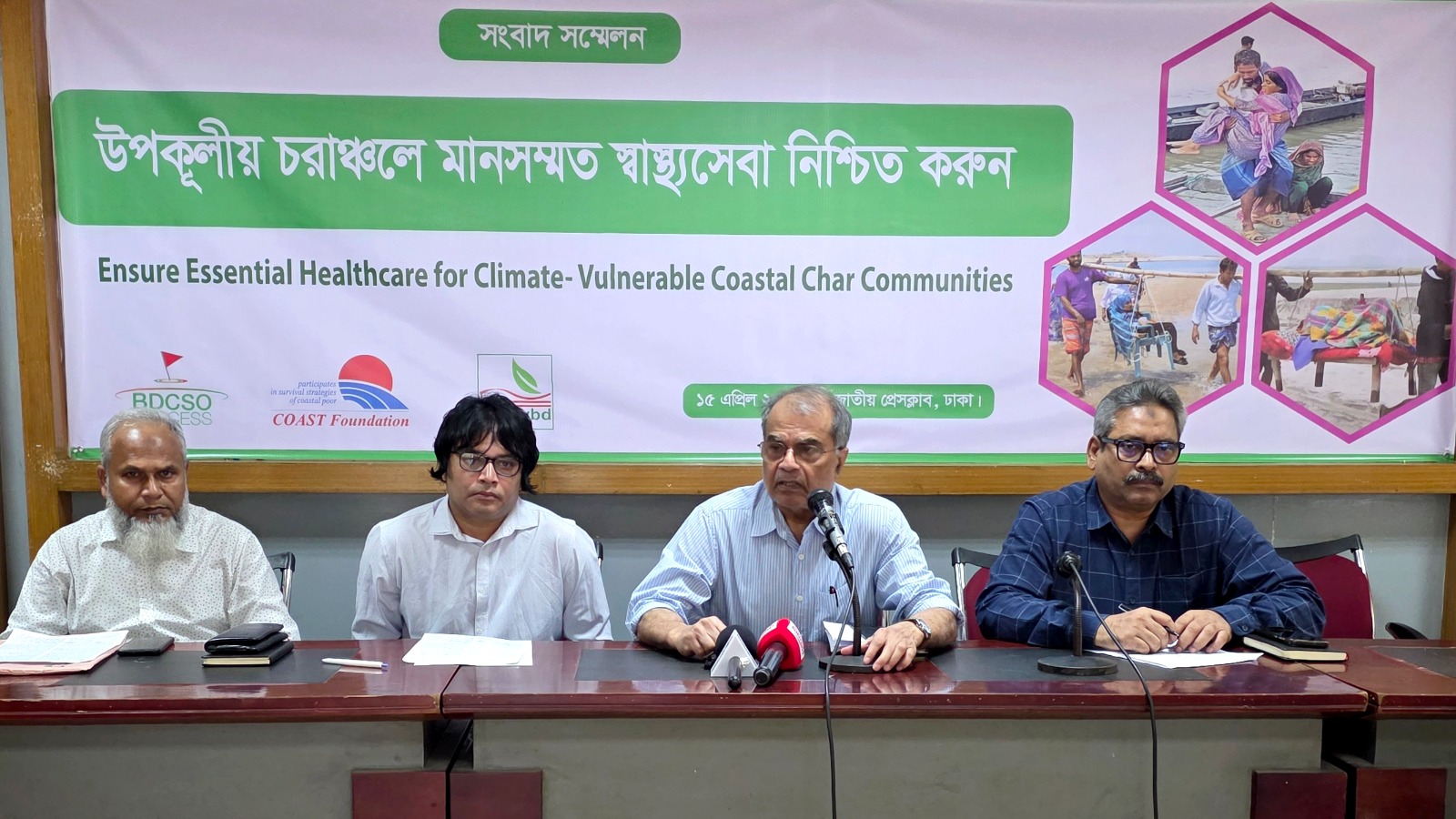
Basic healthcare remains a neglected reality for vulnerable, climate-affected, and isolated coastal char communities. Ensuring healthcare protection for these marginalized populations is now a matter of fundamental justice, speakers said at a press conference.
They highlighted that char dwellers are facing a double crisison one hand the impacts of climate change, and on the other, a severe lack of healthcare services. In these remote char areas, where people struggle daily for survival, the term development will remain merely statistical unless it brings real change. Health for All cannot remain just a slogan; it must be translated into concrete action.
Speakers emphasized the need to improve maternal healthcare services by establishing community clinics and safe maternity centers in char areas.
They also stressed the need to enhance midwives' skills through modern, regular training so they can effectively manage complications.
To ensure accessibility, they called for the introduction of boat ambulances, floating clinics, and mobile medical teams in remote regions. Priority must be given to infrastructure, skilled human resources, and adequate medical supplies to ensure quality healthcare at peoples doorsteps.
These demands were raised at a press conference titled Basic Healthcare: A Neglected Reality in Char Areas, held today on Wednesday (15, April) at the VIP Lounge of the National Press Club in Dhaka.
COAST Foundation, EquityBD, & the BDCSO Process organized this event. It was chaired by M Rezaul Karim Chowdhury, Executive Director of COAST Foundation & Chief Moderator of EquityBD.
Among others, speakers included Mostafa Kamal Akand, Coordinator of BDCSO Process, and Syed Ashraf Hossain of Society for Development Initiatives. M. A. Hasan of COAST Foundation presented the keynote paper.
M. Rezaul Karim Chowdhury, Executive Director of COAST Foundation, stated that nearly 10 million people living in char areas face a dual crisis driven by climate change and limited access to healthcare. During disasters, disrupted communication systems leave these communities isolated, with little to no access to medical services. Inadequate infrastructure, a shortage of skilled personnel, and insufficient medical equipment further deprive them of even basic healthcare.
He emphasized that healthcare is a fundamental right, not a luxury, and called for the expansion of telemedicine through 4G connectivity in char areas to enable access to MBBS doctors.
He also highlighted that maternal and child health remain at high risk, stressing the urgent need for safe maternity care centers and modern, quality training for midwives to manage complex situations effectively.
Mustafa Kamal Akand stated that achieving the Sustainable Development Goals is inconceivable without ensuring comprehensive healthcare services for the vast population residing in char areas. This must be treated as a national priority, with the upcoming budget allocating at least 40 percent to primary healthcare. Furthermore, decisive and targeted measures are imperative to ensure healthcare access for the most remote and marginalized communities by expanding and strengthening community clinics, union health centers, and mobile medical teams across char regions. Addressing this critical gap is not optionalit is an urgent and fundamental responsibility of the state.
M. A. Hasan highlighted examples of numerous chars such as Charhadi in Patuakhali, Charmozammel, Char Jahiruddin, Chatkimara, Nagarpatwari Char, and Char Newton in Bhola, where hundreds of thousands of people live without even minimal healthcare services or community clinics.
He proposed creating a separate budget line titled Char Health Sector instead of treating char areas as part of general rural regions. He urged policymakers to eliminate discriminatory approaches and ensure targeted budget allocation for char communities.
Syed Ashraf Hossain stated that even for basic primary healthcare, residents of char areas must travel to the sub-district and district hospitals. During disasters, disrupted communication leaves them completely cut off from medical services, turning treatable conditions into serious health risks. Maternal and child health are especially vulnerable, with high maternal and neonatal mortality due to inadequate prenatal and delivery services.
He emphasized the urgent need for water ambulances and dedicated emergency transport systems to ensure timely access to healthcare, particularly for pregnant women.
Unauthorized use or reproduction of The Finance Today content for commercial purposes is strictly prohibited.