
- National /
- CSOs demands localization and repatriation roadmap for Rohingya crisis

Shamiur Rahman
Published:2026-05-18 18:29:14 BdST
Only 1pc of JRP funds go to local NGOsCSOs demands localization and repatriation roadmap for Rohingya crisis
The Joint Response Plan (JRP) for the Rohingya and local affected people is adopted every year under the leadership of the United Nations. This is basically a UN-dependent plan. It is a mechanism for their fundraising. There have long been complaints that local and national NGOs in Bangladesh are being deprived of fair funding and direct leadership compared to foreign NGOs in the UN Joint Response Plan (JRP) for the Rohingya crisis.
According to NGO forums, it is essential to provide direct funding and leadership opportunities to local organizations to address disparities and manage costs.
According to Cox's Bazar CSO-NGO Forum and the Coast Foundation’s research shows that the vast majority of JRP funding goes to international organizations and various UN agencies. Although local NGOs are used as contractors or subcontractors, they do not receive direct and adequate funding.
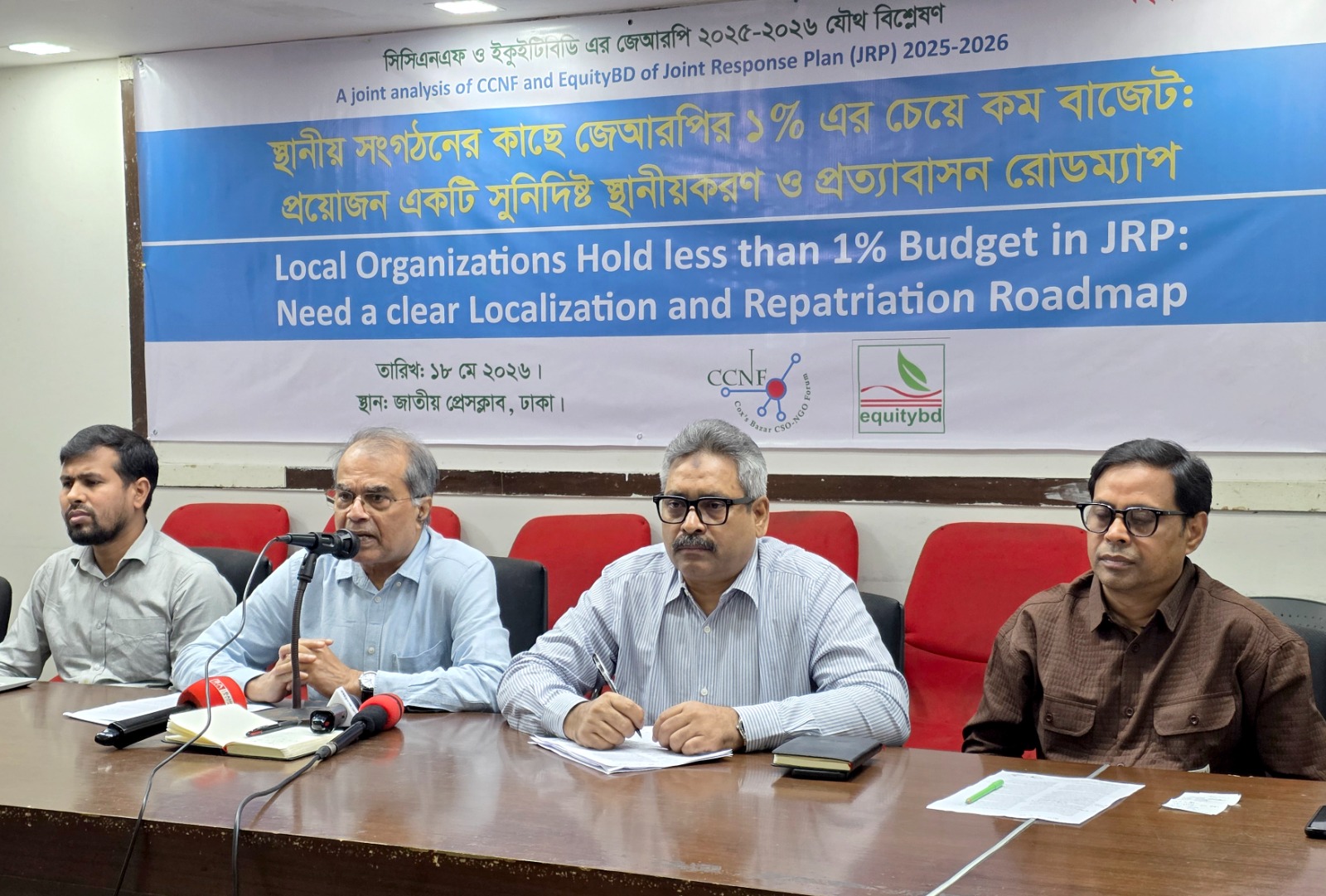
To address this inequality, a roadmap for Rohingya repatriation and localization was demanded at the National Press Club today, May 18 (Monday), under the joint initiative of Cox's Bazar CSO NGO Forum (CCNF) and Equity Justices Working Group (EquityBD).
The press conference, led by CCNF and EquityBD Chief Moderator Rezaul Karim Chowdhury, was also attended by EquityBD Coordinators Mustafa Kamal Akand and Md. Iqbal Uddin, and CCNF Coordinator Md. Shahinur Islam.
Anger over partnership
National organizations have expressed strong dissatisfaction with the decision of the UN Refugee Agency to partner with them, which disregards the capacity of local NGOs. In this context, EquityBD Chief Moderator Rezaul Karim Chowdhury said that the UN Refugee Agency is implementing its projects through various international organizations to work in the Rohingya camps. In this case, they are implementing their work through international NGOs like ACTED, Action Aid and UNICEF TDH. However, a part of their work is supposed to be done through local NGOs. They are not paying attention to that.
Insult to sovereignty
Criticizing the UN refugee agency, Rezaul Karim Chowdhury said, they are building permanent housing in Rohingya camps. For this, they have not taken the opinion of the government, forest department or local people. However, in many countries, the UN cannot do any work without the permission of the government. For example, to work in Nepal, you have to work with the permission of that country. But in the case of Bangladesh, they do not show even the minimum courtesy of taking permission. This is an insult to the sovereignty of Bangladesh and an insult to all the citizens of the country. To protect the interests of the country, the UN should take the permission of the government for all its work.
Criticizing the subservient attitude of high-ranking government officials and the excessive preference given to foreigners, he said, "When international organizations come to Bangladesh, we will respect them and provide them with hospitality, but why should we support their unjust demands or proposals? In this case, the government should take a decision based on understanding the real situation of the country."
He also said that when government officials visit the Cox's Bazar Rohingya camp, they do not want to listen to the local people. They only talk to UN officials. This kind of behavior should be avoided. Because the local people are the worst sufferers of this crisis. They need a permanent solution to their problems, which requires a localization and repatriation roadmap.
Funding shortfall and national crisis
In recent years, aid from donor countries has decreased significantly. Due to this global funding crisis, field-level activities are being disrupted. In this context, Md. Shahinur Islam presented the keynote speech and said that under the leadership of the United Nations, joint assistance plans have been adopted for the Rohingya and local affected people every year.
He criticized the plan, saying that it is essentially a UN-dependent plan. It is a mechanism for their fundraising. Of the total $934.5 million in last year's JRP, 87% of the funds went to the UN, 9% to international organizations, but less than 1% to local NGOs.
He also said that the Bangladesh government is providing significant financial assistance to the Rohingya crisis. The government is even helping in this crisis by taking loans from banks. But these contributions are not reflected in the current JRP structure. Rather, it is mainly being used as a framework for UN-dependent fundraising.
Direct assistance request
Local NGOs demand that they be directly involved in funding and decision-making processes, rather than being left as intermediaries, to reduce the cost of relief efforts.
Shahinur Islam said that at least 25 percent of the JRP funds must be implemented by local NGOs and for local people. And the JRP must include a plan on how much funding will be implemented by whom.
Demand repatriation and war crimes trials
EquityBD coordinator Mustafa Kamal Akand said that the current democratically elected government must take responsibility for the repatriation of Rohingyas. Therefore, a Rohingya Repatriation Commission must be formed for this.
He also said that genocide has been committed against the Rohingya, so a conference for justice and safe repatriation should be organized at the next UN General Assembly session. The main objective of which will be to formulate a repatriation roadmap.
Md. Iqbal Uddin said, "While providing humanitarian assistance to the Rohingya, the environment and forests of Cox's Bazar have been destroyed. 300 acres of agricultural land have been destroyed, and it is important to restore these lands for agricultural purposes. Moreover, the crime rate in the camps has also increased and an average of 1 person is being killed every day in Cox's Bazar."
He said that groundwater must be preserved for future generations. Therefore, he called for purifying the water of the Naf River and supplying it to the Rohingya camps. He said that the Rohingyas should not only be given relief but also work on their civil and political rights.
Unauthorized use or reproduction of The Finance Today content for commercial purposes is strictly prohibited.