Exports fall 13.65% in January–July despite a shrinking market; China and Vietnam gain ground
Bangladesh’s apparel exports to EU take a sharp hit
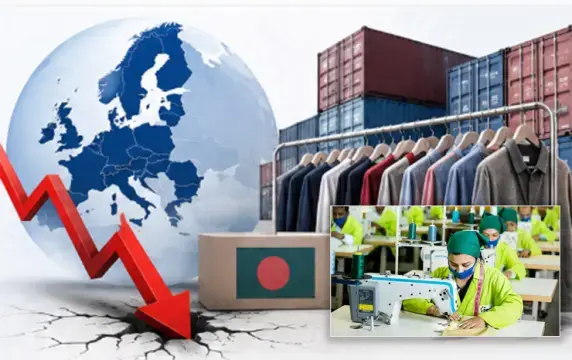
The divergence is significant: Bangladesh’s decline was nearly two-and-a-half times the contraction of the overall EU market
Bangladesh is facing renewed pressure in the European Union’s apparel market, with its garment exports falling sharply even as the bloc’s overall clothing imports contracted at a much slower pace.
During January–July 2026, EU apparel imports from Bangladesh fell 13.65 percent year-on-year, while the bloc’s total apparel imports declined by 5.10 percent, according to Eurostat data.
The divergence is significant: Bangladesh’s decline was nearly two-and-a-half times the contraction of the overall EU market. Meanwhile, China and Vietnam increased their exports to the bloc, raising concerns about Bangladesh’s ability to retain market share and compete on value.
Exports down by €1.64 billion
The EU imported around €12.01 billion worth of apparel from Bangladesh during January–July 2025. The figure dropped to approximately €10.37 billion during the same period this year—a decline of about €1.64 billion.
Export volume also fell, from around 796.98 million kg to 751.91 million kg, a decline of 5.66 percent.
The simultaneous fall in both export value and volume is particularly concerning for Bangladesh, as it suggests that the decline is not solely the result of weaker European demand.
Bangladesh is also receiving lower prices for the garments it sells.
BD’s unit prices fall
Bangladesh’s average apparel export price dropped 8.47 percent, from €15.07 per kg to €13.80 per kg during the period. By comparison, the EU’s overall average apparel import price stood at around €19.84 per kg.
The gap is even more striking among some of Bangladesh’s competitors. Vietnam’s average unit price rose to around €29 per kg, while China’s stood at €20.20 and Cambodia’s at €18.67.
Pakistan, however, recorded a lower average price of €10.77 per kg.
The figures suggest that Bangladesh remains heavily concentrated in relatively lower-value apparel, while some competing suppliers are capturing greater value per kilogram.
China, Vietnam buck the trend
The EU’s overall apparel imports declined from €54.39 billion to €51.61 billion during January–July, with import volume falling by 3.23 percent.
Yet China and Vietnam managed to expand their presence in the shrinking market.
EU apparel imports from China increased 1.89 percent to €16.42 billion, while imports from Vietnam rose 3.92 percent to €2.55 billion.
Vietnam also overtook Cambodia to become the EU’s fifth-largest apparel supplier during the period.
Among other major suppliers, Turkey’s exports fell 13.32 percent, India’s 12.24 percent, Pakistan’s 11.81 percent and Cambodia’s 6.69 percent.
China widens its lead in volume
Bangladesh remains the EU’s second-largest apparel supplier by value, but the gap with China is becoming more pronounced in terms of shipment volume.
China exported around 816.26 million kg of apparel to the EU during January–July, up 4.16 percent from a year earlier.
Bangladesh, by contrast, shipped 751.91 million kg, down 5.66 percent.
The data indicate that China is not only shipping more apparel to the EU but is also achieving a substantially higher average unit value than Bangladesh.
The low-value trap
Industry stakeholders have long called for greater product diversification and a shift towards higher-value apparel. The latest EU data underline the urgency of that transition.
Bangladesh’s average unit export price of €13.80 per kg is less than half Vietnam’s €29 per kg. This means competitors can potentially generate significantly greater export value from comparable volumes.
Mohammad Hatem, president of the Bangladesh Knitwear Manufacturers and Exporters Association (BKMEA), has attributed part of the disparity to Bangladesh’s continued reliance on lower-priced products, while also pointing to intense price competition within the domestic industry.
A brief recovery in June and July
There are, however, some signs that the pace of decline may be easing. Bangladesh’s apparel exports to the EU had fallen 16.43 percent during January–June. By the end of July, the cumulative decline had narrowed to 13.65 percent.
Exports rose 0.87 percent year-on-year in June to around €1.37 billion, while July also recorded year-on-year growth.
But industry observers caution against interpreting two months of improvement as a full recovery. At this stage, the figures may indicate a slowdown in the rate of decline rather than a sustained turnaround.
LDC graduation adds to the pressure
The issue carries added significance as Bangladesh prepares for its graduation from the UN’s Least Developed Country (LDC) category.
The EU is one of the country’s most important destinations for apparel exports. Maintaining competitiveness in the European market will therefore be critical to sustaining Bangladesh’s export growth in the post-graduation period.
Industry stakeholders have pointed to weaker global demand, changing sourcing strategies, production costs, energy uncertainties and growing competition among Asian apparel-producing countries as major challenges.
The shift in sourcing towards higher-value and more diversified products could add further pressure on Bangladesh’s traditional low-cost manufacturing model.
A shrinking market—or a shrinking share?
Mahbubur Rahim Rubel, founder and CEO of Bangladesh Apparel Exchange, recently noted that the contraction in the EU’s overall apparel market has affected Bangladesh as well. But the greater concern, he said, is that China and Vietnam have continued to expand their exports while Bangladesh has experienced a much sharper decline.
That raises a fundamental question for Bangladesh’s apparel industry: Is the country simply being hit by a shrinking European market, or is it losing market share within that shrinking market?
The January–July figures provide grounds for concern on both fronts. With Bangladesh’s exports declining nearly three times as fast as Vietnam’s growth rate and substantially faster than the overall EU market contraction, the challenge is no longer simply about producing more garments.
It is increasingly about what Bangladesh sells, at what price, and how much value it can capture from each shipment.
For an industry that remains central to Bangladesh’s export economy, moving towards higher-value garments, man-made fibre products, technical and functional apparel, greater product diversification and stronger design capabilities may prove crucial to preserving its position in Europe.
The June–July recovery offers some relief. But whether it marks the beginning of a sustained rebound—or merely a temporary pause in a broader loss of momentum—will become clearer in the months ahead.
Shamiur Rahman