Proposed cash withdrawal fees draw public backlash
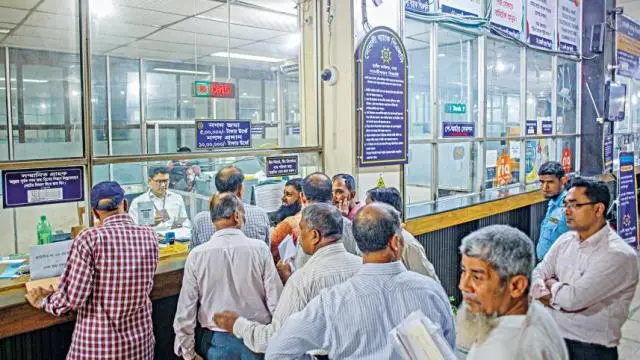
The recommendations also include introducing new fees for 14 other banking services and increasing several existing transaction charges
News of a proposal that would penalize retail bank customers for accessing their own savings has sparked widespread public anxiety and resentment.
The Association of Bankers, Bangladesh (ABB), an organization representing commercial bank executives, has proposed a new penalty fee ranging from Tk100 to Tk300 for any customer withdrawing cash from a bank counter more than three times a month.
The recommendations also include introducing new fees for 14 other banking services and increasing several existing transaction charges.
While the central bank has stepped in to reassure depositors that it will block any unreasonable financial burdens, the mere introduction of the proposal has raised questions about whether maintaining a bank account is becoming unaffordable for the average citizen.
Consumer rights advocates note that the proposal comes at a difficult time, as high inflation continues to drive up the cost of essentials, medical care, education, and transport.
Adding extra fees to cash withdrawals would place the heaviest burden on middle- and low-income households, retirees, and small traders.
Many depositors point out that retail accounts are already heavily taxed by commercial banks through account maintenance fees, annual ATM card charges, SMS notification fees, chequebook issuance costs, and digital platform fees.
Introducing a penalty for counter transactions is viewed by many as an unfair double-taxation on personal savings.
The policy would particularly affect pensioners, senior citizens, and less tech-savvy individuals who rely entirely on branch counters because they find digital apps and online banking difficult to navigate.
Commercial banks justify the proposed changes by citing rising operational overheads, IT infrastructure costs, and global banking practices where transactional services are unbundled and charged separately.
Bankers also state that the penalty is intended to discourage branch visits and push consumers toward ATMs, digital wallets, and internet banking platforms.
- Tk100 to Tk300 fee for counter cash withdrawals exceeding three times a month.
- Tk500 activation fee to reactivate dormant or unutilized bank accounts.
- Multiple-fold increases in loan processing and documentation fees.
- Introduction of 14 new service tariffs alongside upward adjustments to existing fees.
However, market analysts argue that the infrastructure is not yet ready for a sudden shift away from cash counters.
Many rural and semi-urban areas lack sufficient ATM networks. Furthermore, regular network downtime, cash-outages at booths, and software errors frequently leave digital users stranded, making branch counters the only reliable option for many.
Risk to financial inclusion
Financial analysts warn that aggressively raising transaction fees without improving service quality could backfire on the banking sector.
|
Current Operational Grievances |
Potential Economic Consequences |
|
Extended waiting queues and branch service delays. |
Loss of public trust in the formal banking system. |
|
Frequent central server downtimes and app crashes. |
De-banking trends among low-income and rural populations. |
|
Inoperative or un-cashable ATM booths. |
Rise in cash hoarding outside the formal economy. |
If depositing and withdrawing money becomes a costly hassle, retail customers may choose to withdraw their funds entirely and keep physical cash at home.
A shift back to cash hoarding would pull liquidity out of the formal banking system, making it harder for banks to maintain credit lines and secure stable deposit bases.
BB adopts protective stance
In response to growing public concern, Bangladesh Bank has stated it will protect consumer interests.
Imposing excessive fees will discourage the public from using formal banking channels, stated Bangladesh Bank spokesperson and executive director Arief Hossain Khan.
"Any new tariff structure must prioritize depositor welfare. We advise commercial banks to generate revenues through their core lending operations, investment portfolios, and standard credit mechanisms rather than relying on service charges."
Shamiur Rahman