Intelligence failure lets $25m slip away from BD
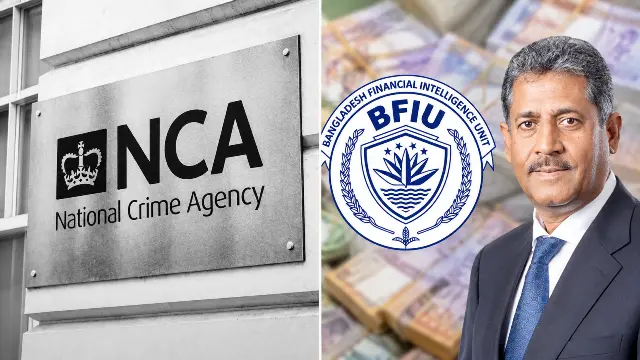
UK agency reportedly alerted Bangladesh to funds linked to former Eastern Bank chairman, but legal follow-up came too late
A potential recovery of $25 million allegedly transferred out of Bangladesh appears to have been lost after Bangladesh failed to provide timely legal and investigative information sought by the United Kingdom’s National Crime Agency (NCA).
The money, reportedly held in an account at the London branch of UBS AG in the name of Mohammad Shawkat Ali Chowdhury, a former chairman of Eastern Bank, was identified by UK authorities while Bangladeshi agencies were investigating allegations of money laundering and illicit wealth accumulation against him.
According to documents reviewed in an initial investigation by The Finance Today, the NCA repeatedly sought information from Bangladesh about the legal status of the investigation, the alleged criminal link to the funds and whether any assets belonging to Shawkat Ali had been seized or frozen in Bangladesh.
But the information and legal basis required to pursue the case in a UK court were reportedly not provided within the crucial period.
The money was subsequently moved from the UK to the United Arab Emirates, according to information cited in Bangladeshi media reports.
The episode has raised questions about the effectiveness of Bangladesh's financial-intelligence and asset-recovery mechanisms at a time when the country is seeking to trace and repatriate billions of dollars allegedly siphoned abroad.
The Bangladesh High Court on August 25 ordered the Anti-Corruption Commission (ACC) to dispose of, within 30 days, an application seeking an investigation into the alleged transfer of the $25 million from the UK to the UAE. It also issued a rule questioning why legal action should not be taken against officials of the Bangladesh Financial Intelligence Unit (BFIU) over alleged inaction in recovering the funds.
A four-week window that Bangladesh lost
The trail began early this year when the UK authorities informed their Bangladeshi counterparts about funds allegedly linked to Shawkat Ali.
According to documents cited in the investigation, the NCA's intelligence identified around $25 million held at UBS AG's London branch.
At the time, Bangladeshi authorities were already examining allegations against Shawkat Ali involving money laundering, corruption, tax evasion, unlawful accumulation of wealth and undisclosed overseas assets.
The NCA sought answers to a series of questions. Who was investigating Shawkat Ali in Bangladesh? What offences were being investigated? At what stage was the investigation? Was there evidence linking the UK-held funds to those offences? And, critically, had Bangladesh taken any legal action against Shawkat Ali or his assets?
The answers mattered because the UK authorities needed a sufficient legal basis to seek further judicial measures to keep the funds frozen.
According to the documents, the NCA indicated that if Bangladesh could establish a connection between the funds and criminal conduct and demonstrate meaningful legal action at home, there could be a basis for pursuing further measures through the UK courts. But that legal foundation was not established in time.
BFIU's responses
On February 22, the BFIU reportedly informed the NCA that Shawkat Ali was a person of interest to Bangladeshi investigative agencies.
Investigations were being conducted by the ACC, the Criminal Investigation Department (CID) of police and the National Board of Revenue (NBR), according to the information supplied to the UK agency.
But the investigations were still at the inquiry stage.
There was apparently no final finding establishing that the $25 million was the proceeds of a specific offence. Nor had assets belonging to Shawkat Ali been seized or attached through a court order in Bangladesh at that point.
The BFIU provided further information on February 25, saying that Shawkat Ali was abroad and was not in custody in Bangladesh.
It also identified officials involved in the separate investigations being conducted by the NBR, CID and ACC.
The BFIU further informed the UK authorities that Shawkat Ali's bank accounts in Bangladesh had been temporarily suspended between July 1 and August 29, 2025, but the suspension had not subsequently been extended.
There had also been no seizure or attachment of his assets in Bangladesh by that time.
This left the UK authorities with intelligence indicating the existence of the funds, but without the corresponding legal action in Bangladesh that could help establish a basis for continued restraint of the money.
The clock was running
The timing was crucial. The NCA had reportedly informed Bangladesh that action was needed before the initial period for restraining the funds expired.
In a February 19 communication, the agency sought clarification on the investigation and Bangladesh's legal position.
Another communication on February 25 reportedly stressed the urgency of taking steps if Bangladesh wanted the UK authorities to seek further judicial measures.
Then, on February 27, the NCA's International Corruption Unit informed Bangladesh that it would take no further action at that stage.
The door, however, was not necessarily completely closed.
According to the information contained in the documents, Bangladesh could still have pursued a domestic criminal case and sought further UK assistance if the alleged conduct constituted an offence in both jurisdictions.
But the critical window for keeping the money in Britain had effectively narrowed. The High Court's August order has now brought the issue under judicial scrutiny in Bangladesh. (The Business Standard)
A legal mismatch
One of the key complications appears to have been the legal basis used by Bangladesh in communicating with the UK.
The BFIU reportedly told the NCA that Shawkat Ali had no approval from Bangladesh Bank to transfer or invest the money abroad.
That could constitute a violation under Bangladeshi law. But establishing jurisdiction in the UK required something more than simply showing that the transfer lacked approval under Bangladeshi foreign-exchange rules.
The issue was whether the conduct underlying the funds could be characterised as criminal conduct recognised in both jurisdictions. That distinction became critical.
The documents indicate that the BFIU's explanation did not provide the UK authorities with a sufficiently clear criminal link between the $25 million and an offence that could support continued restraint through British courts.
In effect, Bangladesh had information pointing to potentially illicit funds, but had not yet developed the domestic legal case far enough to translate that information into an enforceable recovery action abroad.
From London to Dubai
According to the timeline contained in the documents, the UK authorities had information about the funds from January and subsequently identified Shawkat Ali and the UBS account in February.
The $25 million reportedly remained under restraint in London for approximately four weeks. That period represented a crucial opportunity.
Had Bangladesh been able to provide the necessary evidence and legal basis during that window, the UK authorities could potentially have sought further judicial measures to keep the money in Britain.
Instead, the restraint period expired. The money was subsequently transferred to the United Arab Emirates, according to information cited by Bangladeshi media.
The alleged transfer from Britain to Dubai is now itself the subject of a legal and investigative process in Bangladesh. High Court had ordered the ACC to decide within 30 days on a petition seeking an investigation into the alleged transfer and laundering of the $25 million.
The warning came before the money was lost
The chronology has become particularly significant because Bangladeshi authorities had publicly indicated that a large amount of money had been recovered or frozen in Britain.
On June 8, Bangladesh Bank Governor Md Mostaqur Rahman reportedly told the Editors Guild that $25 million in “stolen assets” had been frozen in the UK and that efforts were under way to bring it back to Bangladesh.
The money was not publicly identified at the time. Subsequent developments, however, indicated that the funds had already left Britain.
That discrepancy has added to questions over whether the authorities fully understood the urgency of the UK case and whether information was adequately coordinated among the agencies responsible for asset recovery.
Now Bangladesh is looking to the UAE
With the money reportedly no longer in Britain, Bangladesh's recovery effort has entered a more difficult phase. The BFIU is now seeking cooperation from authorities in the United Arab Emirates, according to information cited by officials and local media.
The shift means that Bangladesh must now establish the legal basis for freezing and recovering the funds under UAE procedures—after missing the opportunity to pursue the money while it was in London.
Meanwhile, Bangladesh has taken steps against Shawkat Ali's domestic assets. On March 15, the NBR's Large Taxpayers Unit reportedly demanded Tk306.87 crore in taxes from him and gave him until March 30 to pay.
If unpaid, the tax authorities may pursue legal measures against assets in Bangladesh, according to officials.
A wider problem for Bangladesh
The $25 million case comes against the backdrop of a much larger challenge.
A government-commissioned white paper estimated that approximately $234 billion in illicit financial flows left Bangladesh between 2009 and 2023, an average of around $16 billion a year. The figure was based on an estimate cited by the white paper committee and has subsequently been referenced by the government. (BSS)
The scale of the alleged outflow has made international cooperation central to Bangladesh's efforts to recover assets.
Tracing the money is only the first step. Authorities must then identify the beneficial owners, establish the criminal or unlawful basis of the funds, secure freezing orders where necessary, meet the evidentiary requirements of foreign jurisdictions and ultimately obtain court orders for confiscation and repatriation.
The white paper also highlighted weaknesses in investigation and prosecution capacity and called for stronger coordination among relevant agencies and greater use of mutual legal assistance mechanisms.
The recovery challenge
Bangladesh has since moved to strengthen its asset-recovery efforts.
An inter-agency task force led by the Bangladesh Bank governor has been formed to coordinate efforts to identify and recover assets held abroad. Joint investigations are also being pursued in a number of priority cases, while Bangladesh is seeking greater legal cooperation with foreign jurisdictions.
But the Shawkat Ali case illustrates a fundamental problem: international asset recovery is often a race against time. Financial intelligence may identify an account, but intelligence alone does not freeze money indefinitely. Foreign authorities need evidence, legal requests and a clear criminal or civil basis that meets the requirements of their own courts.
In the London case, Bangladesh appears to have had a narrow window in which the information supplied by the NCA could have been converted into a stronger legal action.
That window closed. The $25 million then moved from London to Dubai. And Bangladesh is now attempting to recover it from a jurisdiction where the legal and financial trail may be more difficult to pursue.
The High Court's intervention has put the actions of the country's financial-intelligence authorities under scrutiny. But whether the money can ultimately be traced, frozen and brought back to Bangladesh will depend on the strength of the evidence, the progress of domestic investigations and the cooperation of authorities in the UAE.
For Bangladesh, the case is more than a story about $25 million. It is a test of whether financial intelligence can be turned into timely legal action before allegedly illicit assets move beyond reach.
Shamiur Rahman