Sufia Kamal Library Project: Cost Overruns, Delays Raise Red Flags
Tk 621cr library project faces scrutiny over delays, spending
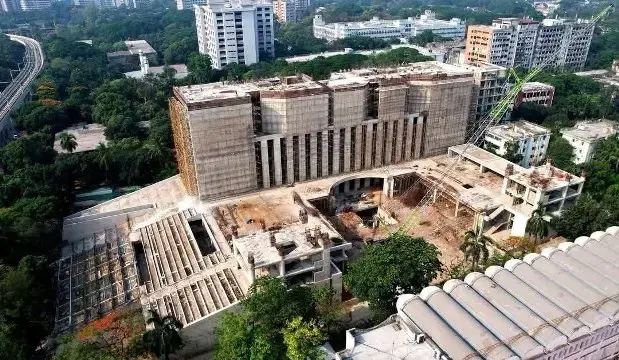
Cost rises to Tk 621cr from Tk 524cr; equipment bought before building completion, temporary facilities cost over Tk 22 lakh a month
Repeated cost revisions, prolonged delays and questionable procurement decisions have put the Sufia Kamal National Public Library modernisation project under scrutiny, raising concerns over the use of public funds and accountability in one of the country's major cultural infrastructure projects.
The project, initially approved at Tk 524.25 crore in May 2021, is now facing a proposed cost increase to Tk 620.88 crore, while its completion deadline has been extended from 2024 to December 2027.
Questions have also been raised over the purchase of lifts, escalators and central air-conditioning systems before the new building was ready, as well as the government's monthly expenditure of more than Tk 22 lakh on temporary facilities.
The project, implemented by the Department of Public Libraries and the Public Works Department (PWD) under the Ministry of Cultural Affairs, involves National Development Engineers Ltd (NDE) as the main cont।ractor and Decon Q Design as the consultant.
Project insiders have alleged irregularities in cost revisions, procurement and contract management. These allegations warrant an independent review of the project's financial and administrative decisions.
Cost escalation continues despite missed deadlines
The project, titled 'Modernisation of Sufia Kamal National Public Library and Construction of a Nine-Storey Building with Two Basements', was approved in May 2021 with an estimated cost of Tk 524.25 crore.
The first revision raised the cost to Tk 561.30 crore. Now, a second revision proposal seeks an additional Tk 60 crore for construction work, taking the projected expenditure to Tk 620.88 crore, according to project sources.
A further Tk 40–50 crore has reportedly been proposed for electromechanical components.
The project was originally scheduled for completion in 2024. However, construction delays have pushed the proposed completion date to December 2027.
The repeated revisions have raised questions about the justification for additional spending and the failure to complete the project within the original timeframe.
Several project-related sources alleged that repeated variations in the scope of work may have created opportunities for irregularities involving officials, contractors and consultants.
A detailed breakdown of additional costs, including design changes, market price adjustments and administrative delays, is needed to establish the reasons behind the escalation.
Contractor's performance under scrutiny
Demolition of the old library building began in April 2022, with the new structure initially expected to be completed by June 2024. However, progress has reportedly fallen behind schedule.
The contractor has cited difficulties in importing materials and the dollar crisis as reasons for the delay. Sources involved in project monitoring, meanwhile, have pointed to possible shortcomings in manpower deployment, coordination and construction management.
Under the terms of public procurement contracts, authorities may take action against contractors for delays, including imposing applicable penalties.
Questions have therefore arisen over why the contractor's deadline was repeatedly extended and whether contractual provisions were properly enforced.
Stakeholders have called for a review of work orders, progress reports, payment records and variation approvals to determine responsibility for the delay and additional expenditure.
Lifts, escalators purchased before building was ready
One of the most significant concerns relates to the procurement of expensive electromechanical equipment.
According to project insiders, lifts, escalators and central air-conditioning systems were purchased before the nine-storey building was ready for installation.
The decision has raised questions over procurement planning, financial prudence and the risk of equipment deterioration during prolonged storage.
With construction still incomplete, concerns have emerged over the equipment's storage conditions, warranty periods and maintenance costs.
Sources alleged that some officials had pushed for early procurement for personal financial benefit. These allegations could not be independently verified.
A review of the procurement timeline, delivery records, storage arrangements and warranty conditions is necessary to determine whether the purchases were made in the public interest.
Temporary facilities costing Tk 22 lakh monthly
The relocation of nearly 300,000 books to the Institution of Engineers, Bangladesh (IEB), during construction has created another source of expenditure.
The temporary library operations at IEB are reportedly costing the government Tk 16 lakh a month.
In addition, more than Tk 6 lakh is being spent monthly on administrative operations at a floor rented from Bangladesh Services Limited (BSL), near Hotel InterContinental.
Together, the temporary arrangements cost more than Tk 22 lakh a month, or over Tk 2.64 crore annually.
With the project deadline extended until 2027, the government faces a prolonged financial burden.
Questions have also been raised over the reported storage costs of the books, with critics describing the expenditure as disproportionately high.
The full rental agreements, payment records and basis for determining storage costs should be made public to establish whether the expenditure was justified.
The delays have also restricted public access to library services, affecting students, researchers and regular readers.
Demolition of old building raises heritage concerns
The decision to demolish the old library building has also drawn criticism from urban planners and heritage advocates.
The structure reportedly featured a distinctive pyramid-shaped staircase and architectural elements reflecting nearly 67 years of history.
Critics have questioned whether the building's historical and architectural significance was adequately assessed before demolition.
The Institute for Planning and Development (IPD) has also reportedly criticised the decision, arguing that modernisation should not overlook the importance of architectural and urban heritage.
However, the technical condition of the old structure, its safety, renovation feasibility and the alternatives considered before demolition need to be examined through relevant documents.
Officials remain unavailable for comment
Repeated attempts were made to contact Niaz Md Tanvir, executive engineer (E/M-4) of PWD, regarding the allegations. He did not answer phone calls or respond to a WhatsApp message.
Masud Rana, executive engineer (Division-4), involved in the project's infrastructure construction, was also contacted several times for comment but did not provide an interview opportunity.
Their responses could not be obtained before publication.
Calls for independent review
The Sufia Kamal National Public Library is a key public institution serving readers, students and researchers. Delays in its modernisation have therefore affected not only public finances but also access to essential educational and research facilities.
Some questions raises interest that Why has the project cost continued to rise? Who is responsible for the construction delays? Was the early purchase of expensive equipment financially justified? And could the substantial rental expenditure have been avoided through timely completion?
An independent technical and financial review of the original and revised Development Project Proposals, procurement plans, work orders, variation approvals, contractor payments and audit objections is necessary.
The review should also establish whether the additional expenditure resulted from legitimate changes in project requirements or failures in planning, procurement and implementation.
Ultimately, ensuring transparency, accountability and timely completion should be the priority. A public library project should be measured not by the amount of money spent, but by the quality of services it delivers to the people.
Shamiur Rahman