FM flags banking-sector governance, investment and job creation as key challenges
Inflation control, tax reform top economic priorities: Khosru
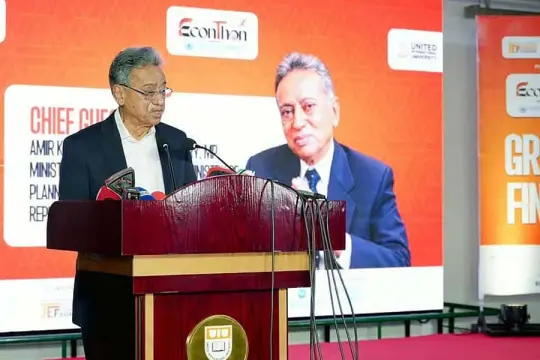
The minister made the remarks as chief guest at the Grand Finale of ECONTHON 2026, a national inter-university economics competition, held at United International University (UIU) in the capital
Finance Minister Amir Khosru Mahmud Chowdhury has identified controlling inflation, restoring macroeconomic stability, reforming the tax system and strengthening banking-sector governance as the government's top economic priorities, warning that global uncertainty and domestic structural weaknesses pose significant challenges to Bangladesh's growth prospects.
Speaking at the grand finale of ECONTHON 2026, a national inter-university economics competition held at United International University (UIU) in Dhaka on Saturday, he stressed the need to restore confidence in the banking sector, boost private investment and create employment.
Inflation continues to erode people's purchasing power, while Bangladesh's tax-to-GDP ratio remains far below the level needed to finance its development ambitions, Khosru said, underscoring the urgency of making tax collection fairer, simpler and more technology-driven.
He also called for evidence-based policymaking and greater accountability in public spending, particularly in education, healthcare and social protection, saying the effectiveness, cost and distributional impact of government policies must be carefully assessed.
"There is no benefit in hiding problems; acknowledging them is where solutions begin," he said.
The minister warned that Bangladesh's import dependence and export-oriented economy left it vulnerable to global headwinds, including slower economic growth, higher financing costs, rising protectionism, tariff barriers, geopolitical conflicts and mounting losses from climate change.
"Uncertainty in the global economy has become a normal reality," he said, noting that external shocks directly affect domestic commodity prices, exchange rates and export orders.
Khosru also stressed that Bangladesh must strengthen its competitiveness as it prepares to graduate from the least developed country (LDC) category, arguing that future export performance would increasingly depend on productivity and competitiveness rather than preferential trade arrangements.
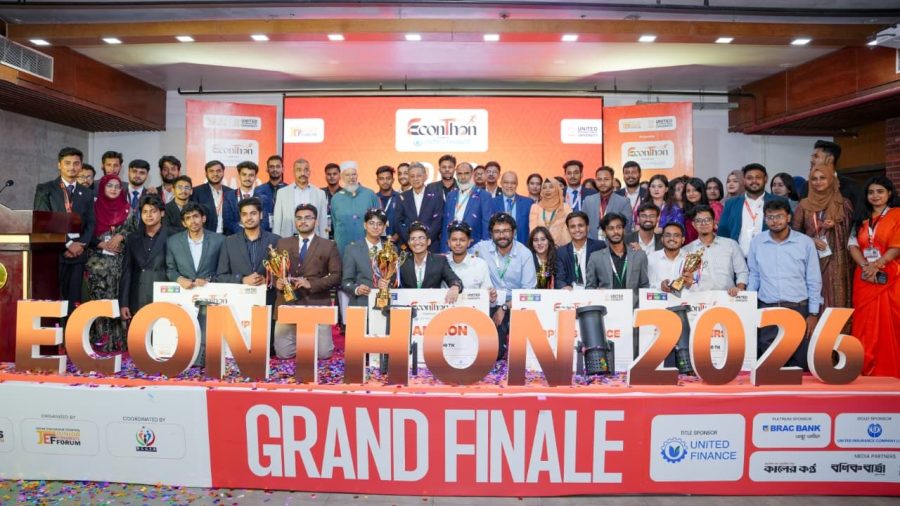
The event was organised by UIU's Junior Economists Forum in collaboration with the university's Department of Economics.
Hasan Mahmood Raja, chairman of UIU's Board of Trustees and chief adviser of United Group, attended as guest of honour, while KMA Shamim, a member of the board and adviser to United Group, attended as special guest.
UIU Vice Chancellor Md Abul Kashem Mia presided over the programme, moderated by Mohammad Omar Farooq, head of the university's Department of Economics.
A total of 224 teams from universities across the country registered for the competition, which aimed to help students apply economic concepts to real-world challenges while developing analytical, problem-solving and decision-making skills.
The competition offered total prize money of Tk 265,000. North South University's team "Vini Vedi Vici" won the championship and received Tk 100,000. The University of Dhaka's team "Shield" finished first runner-up, winning Tk 75,000, while UIU's "Dhaka-99" secured second runner-up and received Tk 50,000.
Shamiur Rahman