Illicit Funds Increasingly Flowing to Financial Hubs
BD’s illicit outflows surged to $1.33bn in 2022: TJN
The TJN data of illicit financial flows (IFF) shows that several jurisdictions repeatedly featured among the top destinations for Bangladesh's illicit capital outflows, including the British Virgin Islands, Cayman Islands, Hong Kong, Singapore, Switzerland, the Netherlands, Ireland and Luxembourg
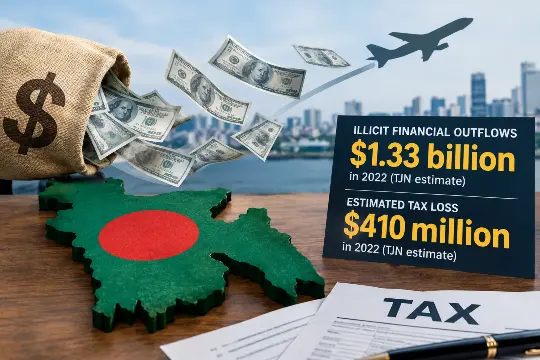
Bangladesh's illicit capital outflows reached a seven-year high of US$1.33 billion in 2022, with the associated tax loss estimated at around $410 million, according to an analysis of data compiled by the UK-based Tax Justice Network (TJN).
The data show that Bangladesh recorded a total of around $4.21 billion in estimated illicit financial outflows between 2016 and 2022, with the destinations increasingly comprising a mix of traditional offshore financial centres and major international financial hubs.
Overall, estimated illicit outflows increased more than sixfold between 2016 and 2022. The tax loss is calculated separately from the illicit financial outflow. It is estimated by applying Bangladesh's corporate income tax rate to the corporate component of illicit financial flows and its personal income tax rate to a standard interest rate applied to the offshore wealth component.
The TJN data of illicit financial flows (IFF) shows that several jurisdictions repeatedly featured among the top destinations for Bangladesh's illicit capital outflows, including the British Virgin Islands, Cayman Islands, Hong Kong, Singapore, Switzerland, the Netherlands, Ireland and Luxembourg.
These jurisdictions have also featured prominently in international assessments of financial secrecy and corporate tax-haven activity.
Professor Mustafizur Rahman, distinguished fellow of the Centre for Policy Dialogue (CPD), said the countries appearing in the data should not necessarily be considered the ultimate destinations of the funds. Many of those countries are used as transit points for capital outflows to shift money to other countries."
Countries with flexible tax and investment regimes and strict confidentiality of banking information can become favourable destinations or intermediaries for cross-border capital movements, he added.
Dr Mustafiz also noted that the TJN estimates differ from those of Global Financial Integrity (GFI), which has focused on illicit financial flows associated with trade misinvoicing, including under- and over-invoicing.
On March 2026, a GFI finding says Bangladesh lost an estimated $68.3 billion through trade-related illicit financial flows between 2013 and 2022 (averaging about $6.8 billion annually).
The TJN methodology covers several forms of illicit financial activity. In the case of multinational companies, it estimates profits shifted to low-tax jurisdictions by comparing reported profits with the profits that would normally be expected based on a country's economic activity.
The TJN also estimates offshore wealth, covering wealth belonging to residents that is held abroad but not properly reported. Its calculations examine unusually large cross-border bank deposits and investments against what would normally be expected from the economic relationships between countries.
Because these figures are estimates based on statistical methodologies, they may vary depending on the methodology and year used, the TJN says.
Sharp rise after 2020
Bangladesh's estimated illicit financial outflows stood at $115 million in 2016, and $197 million in 2017 before rising to $584 million in 2018 and $605 million in 2019.
The outflow declined to $327 million in 2020, coinciding with the Covid-19 pandemic, but surged to $1.05 billion in 2021 and further to $1.33 billion in 2022, the highest level recorded during the seven-year period.
The 2022 figure was around 27 percent higher than in 2021 and more than four times the 2020 level.
Shift towards financial hubs
The destination pattern indicates that Bangladesh's illicit capital movements have been routed through a combination of traditional offshore centres and mainstream international financial and corporate hubs.
Hong Kong featured among the top 10 destinations in all seven years from 2016 to 2022, while the Cayman Islands also appeared in the top 10 throughout the period.
The British Virgin Islands featured in six of the seven years and ranked first in 2022, followed by Hong Kong and the Cayman Islands. The Cayman Islands ranked first in 2016, 2017 and 2021, while Hong Kong topped the list in 2018, 2019 and 2020.
Singapore was another recurring destination, while the Netherlands, Ireland, Switzerland, Luxembourg and the United Kingdom repeatedly appeared among the leading jurisdictions.
The composition of the top 10, however, changed from year to year. Jersey and Bermuda featured prominently in 2021, while Mauritius, Denmark and Chile entered the top 10 in 2022. Portugal appeared in 2018, while Spain featured in 2016-17.
The changing composition suggests that illicit capital movements may increasingly be routed through a combination of traditional offshore centres, financial hubs, corporate holding jurisdictions and financial intermediaries, rather than being concentrated in a single group of offshore destinations.
Shamiur Rahman