Govt urged to shift from emergency relief to long-term social investment
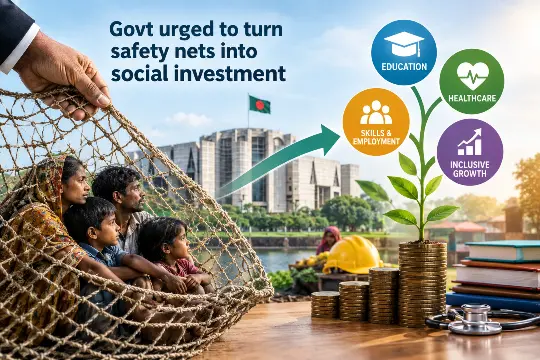
Speakers at the Bay of Bengal Conversation 2026 call for stronger social insurance, better data and protection for informal workers
Bangladesh needs to move beyond emergency relief and build a long-term social protection system capable of raising productivity and helping people withstand economic and climate-related shocks, speakers at a policy discussion have said.
They called for a dynamic national social database, universal life-cycle social insurance, wider protection for informal workers and public spending that reflects the country’s changing demographic and economic realities.
The recommendations came during a session titled “Beyond the Safety Net: 10 Years of Social Protection Reforms and What Comes Next” on the second day of the three-day Bay of Bengal Conversation 2026, hosted by the Centre for Governance Studies (CGS) at a hotel in Dhaka.
Speaking at the session, Prime Minister’s Political Adviser Zahir Uddin Swapon said Bangladesh was fundamentally restructuring its social safety-net system to make it more resilient.
Reflecting on a decade of implementing the National Social Security Strategy and drawing lessons from countries including Brazil, India and Malaysia, Swapon said social spending should be viewed not simply as welfare expenditure but as a productive investment.
“Our target is to move from passive assistance to productive systems so that no Bangladeshi facing hardship is left alone,” he said.
Climate shocks and urban poverty
Swapon said the challenges facing Bangladesh had changed significantly over the past decade. Climate change is increasing the frequency and cost of floods, cyclones and other disasters, while urban poverty is becoming more complex.
“Informal employment remains widespread, families face inflation, health expenditure, unemployment and sudden loss of income,” he added.
He also stressed the need to simplify access to government support, saying citizens should not have to visit multiple government offices to receive different services.
The government is introducing family, farmer and probashi cards linked to digital registries, he said. Such infrastructure, according to Swapon, would allow assistance to be delivered more directly and transparently while enabling the government to respond quickly to climate disasters and economic crises.
Better data, wider social insurance
Mohammad Abdur Razzaque, chairman of RAPID Bangladesh, said the newly introduced family card initiative could reduce errors in beneficiary selection if it was supported by accurate and comprehensive household data.
He called for overlapping allowance schemes to be consolidated and urged authorities to accelerate the nationwide expansion of social insurance programmes, including coverage for workplace injuries and maternity protection.
While welcoming the government’s commitment to allocate 3 percent of GDP to social security, Razzaque warned that rapid industrial automation was creating new pressures in the labour market.
He pointed to Bangladesh’s garment industry, where exports have quadrupled while the number of workers has remained largely unchanged.
The trend, he said, underlined the need for portable social protection, allowing workers to retain benefits as they move between jobs and sectors.
Demographic change
Nazneen Ahmed, executive director of the Centre for Policy Dialogue (CPD), called for social protection planning and budgeting to be guided by demographic trends.
Bangladesh needs to prepare for population shifts and changes in the labour market, she said.
Max Tuñón, country director of the International Labour Organization (ILO), highlighted the pilot Employment Injury Scheme, which replaces lump-sum compensation with monthly pensions.
He recommended extending the scheme to workers in other high-risk industries, including ship recycling.
Australia also reaffirmed its support for Bangladesh’s social protection reforms. Syed Haider, head of development cooperation at the Australian High Commission, identified five priority areas: child well-being, climate-responsive social protection, stronger local governance, protection for informal workers and mobilisation of domestic resources.
Lessons from Malaysia and the Maldives
Former Malaysian minister Zuraida Kamaruddin shared Malaysia’s experience of centralising social protection data to prevent duplication across ministries.
She also stressed the importance of reintegration programmes for returning migrant workers and greater housing security in urban areas.
Mariyam Nasir, director general at the Maldives Education Ministry, recommended creating a coordinated, single-entry point for welfare services across a person’s life cycle.
Such a system could reduce duplication and strengthen public confidence in government institutions, she said.
Shamiur Rahman